Category Archives: Reviews

2025 GMC Acadia: 5 reasons to love it, 2 reasons to think twice

The GMC Acadia has had a bit of an identity crisis over the years, varying in size with each redesign. In its most recent rendition, the midsize SUV comes as family-oriented as ever, complete with seating for up to eight passengers and all the safety tech you could ask for. On top of that, it starts at under $43,000.

The GMC Acadia entered its third generation with a full redesign for the 2024 model year. Unsurprisingly, there’s not much on the docket for the 2025 model. The base Acadia Elevation trim switches out captain’s chairs for a standard second-row bench seat, and all models gain added towing capability.

2024 GMC Acadia

GMC

Related: Toyota Tacoma vs. Ford Ranger: which midsize truck wins in 2025?

Reason to love it #1: Spacious third row

Whereas the third row in most midsize SUVs is severely lacking in terms of space, that isn’t the case in the 2025 GMC Acadia. The latest model features enough third-row space that adults can sit in relative comfort.

The third-row headroom measures 38.23 inches, while the shoulder room is a pretty spacious 57.94 inches. Hip room comes in at 48.62 inches, and legroom rounds it out at 32.14 inches. Considering the GMC Acadia measures 203.96 inches in length, a rather spacious third row isn’t all that surprising.

2024 GMC Acadia

John Beltz Snyder

Reason to love it #2: Seating for up to eight passengers

The GMC Acadia rides on the same platform as its Buick cousin, but that doesn’t mean seating is identical in both models. While the Buick Enclave seats up to seven passengers, the Acadia offers seating for up to eight, putting it a step ahead of competitors like the Ford Explorer as well.

2024 GMC Acadia

GMC

Related: 2025 Lincoln Aviator: 5 reasons to love it, 2 reasons to think twice

Reason to love it #3: Plenty of cargo space

With a maximum cargo volume of 97.5 cu. ft. with both rear rows of seats folded down, the 2025 GMC Acadia boasts plenty of space for luggage and longer items. That’s more cargo space than most three-row competitors, including the Ford Explorer, which tops out at 85.8 cu. ft. in its most spacious trim level.

2024 GMC Acadia

GMC

The GMC Acadia allows you to travel with family and bring all your cargo along for the ride. With all three rows upright, the Acadia offers 23 cu. ft. of cargo space. Folding down the third row increases space to 57.3 cu ft. The Ford Explorer falls short on both measurements, with 16.3 cu ft. behind the third row and 46 cu ft. with the third row folded down.

Reason to love it #4: 328 horsepower comes standard

The GMC Acadia is a three-row midsize SUV, but it has enough power to avoid lagging behind. The standard turbocharged 2.5-liter four-cylinder engine rocks out with 328 horsepower and 326 lb-ft of torque.

2024 GMC Acadia

GMC


View the 10 images of this gallery on the
original article

Those who despise CVTs can breathe a sigh of relief as all that power comes channeled through an eight-speed automatic transmission. The base Elevation trim comes equipped with front-wheel drive, but you can upgrade to all-wheel drive.

Related: Is the 2025 Toyota Tacoma TRD Sport worth $40,895?

Reason to love it #5: Capable of towing up to 5,000 lbs.

For the 2025 model year, all GMC Acadia models come equipped with the Trailering package. In addition to a standard 5,000-lbs. maximum towing capacity, the Acadia also gains a Class III hitch and a hitch view in the rearview camera system.

With its new standard towing capacity, the GMC Acadia is on par with competitors like the Ford Explorer and Honda Pilot. Notably, the Chevrolet Traverse can also tow up to 5,000 lbs.

2024 GMC Acadia

John Beltz Snyder

Reason to think twice #1: Too similar to the Chevrolet Traverse

The 2025 GMC Acadia rides on the same platform as the Chevrolet Traverse and Buick Enclave, putting it in a rather tough spot. While it’s a step up from Traverse, it doesn’t quite match the luxury of the Enclave.

2024 GMC Acadia

GMC

The Acadia’s base price reflects that as well, with the 2025 model starting at $42,900. The 2025 Chevrolet Traverse rolls in at $40,700, and the Buick Enclave is available from $45,100.

Related: Mercedes reportedly working on “baby G-Wagen” variant

Reason to think twice #2: All-wheel drive isn’t standard

Despite its rugged design, all-wheel drive doesn’t come standard on the base Elevation or range-topping Denali trims. Upgrading to an AWD system will cost you an additional $2,000, pushing the base Acadia Elevation up to $44,900.

If you want the luxury-spec Denali trim with AWD, it’ll cost you $56,100. On the bright side, the mid-range Acadia AT4 trim comes with standard AWD, but it starts at a fairly hefty $51,400.

2024 GMC Acadia

GMC

Final thoughts

The 2025 GMC Acadia comes with plenty of standard amenities, but it’s up to the individual buyer to determine if the spec list warrants the price. Before you buy, I’d say the Chevrolet Traverse, Buick Enclave, and Honda Pilot warrant a test drive.

Love reading Autoblog? Sign up for our weekly newsletter to get exclusive articles, insider insights, and the latest updates delivered right to your inbox. Click here to sign up now!

Related: What if Hyundai revived the Tiburon to challenge Honda’s new Prelude?

2025 GMC Canyon: 6 reasons to love it, 3 reasons to think twice

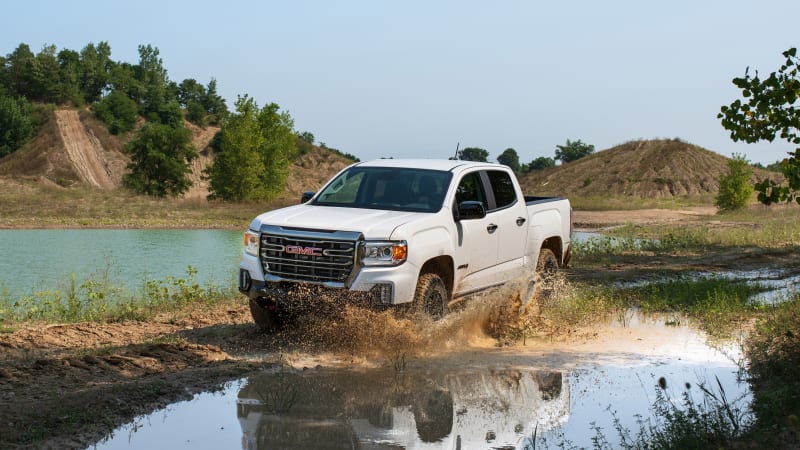
The 2025 GMC Canyon is not only one of the most capable off-road pickup trucks in its class; it’s one of the most powerful as well. Unfortunately, to get that top trim off-road performance, you’ll have to shell out a ton of bread. Fortunately, even the base models are mighty capable. 

GMC Canyon

GMC

Other than a cosmetic blackout package called the “Nightfall Edition,” the only exterior updates this year are a few new colors, namely Glacier Metallic, Desert Sun, and Rapids Metallic. The “ProGrade Trailering System” and the “Safety Plus Package” are also now standard on all Canyons.

Considering how new this generation is, we weren’t expecting that many changes, so this was a pleasant surprise for folks who want the base model Elevation trim. That being said, what are some of the Canyon’s best selling points, and what are some reasons that might lead you to shop elsewhere?

Optional goodies include underside cameras, AEV-built armor, and provisions for a winch. 

GMC

Related: Whatever happened to Canoo?

Reason to love it #1: This is one handsome devil 

This exterior design, which was introduced as the 2023 model, is bold and unique. Yes, the Chevrolet Colorado is its brother, but the Canyon has a unique nose, tail, and accessories. Even the base Elevation trim sits high and has a wide stance. 

Despite its midsize status, the Canyon looks big and has a presence in the real world. I would go so far as to say that when it’s loaded up with AEV accessories, it’s one macho-looking hombre. Still, even the bare-bones WT trim is handsome and distinctive. 

Only one engine, one transmission available – and it’s a brute. 

GMC

Reason to love it #2: The powertrains provide some top-notch grunt 

Even though General Motors ditched the excellent I4 turbodiesel when this new model came out, they replaced it with one of the most powerful gasoline engines in its class. Every trim of the 2025 GMC Canyon uses the same turbocharged 2.7-liter engine that makes 310 hp and 430 lb-ft of torque. While the horsepower is far less than the Ford Ranger Raptor’s 405 hp, it makes just as much torque. 

Thus, it’s not as fast as the Ranger Raptor, but it’s still quick. The Canyon’s 0 to 60 mph times have been reported to be well under 7 seconds. It’s also more efficient, with EPA ratings of 18 mpg city and 22 mpg highway, compared to the Ranger Raptor’s 16 mpg city and 18 mpg highway ratings.

Related: 2025 Lexus NX: 4 reasons to love it, 2 reasons to think twice

Several different colors and textures to make this pickup look special inside. 

GMC

Reason to love it #3: The interior is a step up from basic pickup trucks 

The Canyon comes with an 11.3″ diagonal touch-screen, an 11″ diagonal color Driver Information Center, and an optional 6.3″ diagonal multi-color head-up display in higher trims.

Many standard features are available on the lower models, while others, like heated & ventilated seats and a heated steering wheel, are optional on all but the Denali. 

Related: 2025 Toyota Corolla LE buyer’s guide review: Features, pricing and specs

I’m impressed with the nice details in the base model Elevation, such as the subtle and tasteful use of faux metal trim, excellent screen placement, and attractive interior design.

If you choose the next-level AT4, you will be upgraded to contrasting-color trim pieces with matching synthetic leather and cloth seating. The Denali adds leather throughout the cabin, real-looking wooden inserts, and lots of extra tech. Lastly, the AT4X uses lots of white and red leather with optional AEV badges, should you opt for that package.

The Canyon even offers best in class towing. 

GMC

Reason to love it #4: Towing and payload numbers are impressive 

When properly equipped, the GMC Canyon can tow a maximum of 7,700 lbs. That’s best in class, and I can attest it’s a great little truck to tow with. Its maximum payload of 1,720 lbs is second in its class, but it still rivals many full-size pickup trucks in the market. 

Keep in mind that those numbers drop when you go up to higher trims with additional hardware. The weight and drag coming from things like larger tires, beefier off-road suspension, and armor reduce hauling capability, 

Related: 2025 Ram 1500 Tungsten Review: An all-American deluxe truck

Reason to love it #5: Outstanding daily driver 

As great a work truck as it is, the GMC Canyon doubles as a terrific daily driver. Its overall size isn’t much smaller than that of a full-size pickup truck, but it’s easier to maneuver, park, and store. Its excellent power also makes passing, overtaking, and off-the-line speed a relative breeze.

Front and rear lockers, excellent ground clearance and chunky tires are only part of the package. 

GMC

Reason to love it #6: One of the best 4x4s on the market

Even the base model 4WD Canyon comes with the tried and true Eaton G80 automatic locking rear differential. It spools up and locks at low rpm, and it works automatically. A driver-selectable full-locking rear differential is available, and you can even add both front and rear lockers with the AT4X package. 

The Canyon has 9.6 inches of ground clearance right out of the box, which can be upgraded to 12.2 inches if you opt for the AT4X. That trim also includes the Dynamic Suspensions Spool Valve (DSSV) Multi-Matic shocks, which use proven racing technology to self-adjust for any terrain. 

Related: 2025 Nissan Leaf: 4 reasons to love it, 3 reasons to think twice

At the top of the off-road tree sits the Canyon AT4X AEV Edition. In addition to knobby Goodyear Wrangler Territory MT LT315/70R17 mud-terrain tires, the AT4X AEV Package delivers serious underside protection, advanced suspension, rugged tires, locking differentials, increased ride height, and impressive power.

One bed size, one cabin layout and just one powertrain. 

GMC

Reason to think twice #1: One size must fit all 

Some wish GMC would give the public more layout choices than the single cab configuration and five-foot bed.

The space inside the cab is also a bit tight in the back seat. Unexpectedly, the two odd ducks among the midsize pickup truck gang, the Jeep Gladiator and the Honda Ridgeline, have the most useable and comfortable backseat space.

The Chevy is a compelling alternative. 

Chevrolet

Reason to think twice #2: Its Chevrolet Colorado brother might be better

The bottom line is that you can get a comparable Chevrolet for thousands less. A Chevrolet Colorado WT 4WD with no packages will run up to $8,000 less than a GMC Canyon Elevation.  Even if you opt for the beefier engine on the Chevrolet, the savings remain in the thousands. 

Yes, the interior design is not quite as fancy as GMC’s setup, and there are fewer goodies available overall, but that’s not a dealbreaker for some. I would compare and contrast the GMC with the Chevrolet if you’re concerned about price. 

Speaking of price.

There’s nearly a $30,000 difference between the base model to the very top of the Canyon lineup. 

GMC

Related: It turns out that Akio Toyoda was right

Reason to think twice #3: Price, price, price… 

Buckle up, buttercup, because these prices are going to create turbulence. The base model Elevation starts at $39,995, and it’s a whopping $3,300 to get the 4WD option. The AT4 is $47,295 with standard 4WD, while the Denali is even pricier at $53,595, albeit also with standard 4WD. 

In terms of packages, the AT4X is priced at $6,980, while the Nightfall Edition comes in at $4,595. Both options are worth considering if you’re looking to enhance the functionality or add a touch of pizzazz to your Canyon. The good news is that the AT4X AEV Edition package was at least discounted from $10,000 to $8,000. 

2025 Ford Ranger Raptor

Ford

All in all, a fully loaded 2025 GMC AT4X AEV Edition will run you around $68,000. Add a few options, and you will be well into the $70,000 zone. Yikes. 

Just so we’re clear: a 2025 Ford Ranger Raptor, one of the best vehicles in this class, starts at about $56,000 and peaks at under $60,000. 

Final thoughts 

As I’ve said about the Ford Ranger Raptor, Toyota Tacoma TRD Pro, and similar trucks, resisting the allure of the top-tier models can still land you an outstanding pickup truck.

If you do opt to pay to play, then you will get one of the most capable off-road vehicles sold in the United States right out of the box, a theory that also applies to the 2025 GMC Canyon.

Related: Meet the Cadillac that hits 0-60 in under 3.4 seconds

GMC Sierra EV first drive: A shockingly agile elephant

The 2025 GMC Sierra EV is the newest electric pickup from GM’s luxury brand, combining practicality, performance, and a touch of premium appeal.

But how does it measure up against rivals like the F-150 Lightning, RAM 1500 REV, and Tesla’s Cybertruck? I traveled to California for a hands-on experience with this new electric truck, and it left a solid impression.

Dave McQuilling/Autoblog


View the 16 images of this gallery on the
original article

There’s plenty of power, should you need it

Night follows day, ducks float, and EVs have a good amount of power about them. These are all facts of life, and the Sierra EV is in no way an exception to the rule. You can go from 0-60 in 4.5 seconds in most ci,rcumstances and all of that power is pretty linear.

The only time this may be an issue is in a flat-out sprint. The Sierra EV doesn’t have any kind of launch control, and power delivery can be a bit inconsistent off the line. It’s undeniably quick, but keeping it in a straight line can be a struggle, and that’s not a lot of fun with something of this size.

Related: 2025 Ford Ranger: 4 reasons to love it, 2 reasons to think twice

Despite its size, the Sierra EV handles curves very well

Pickup trucks usually aren’t your first choice when it comes to something to maneuver along sweeping, curvy, mountain roads. A well-balanced, low-slung, sports car tends to be a better option for obvious reasons.

However, the Sierra EV didn’t do too badly when tasked with a series of winding mountain paths. I was very aware of the vehicle’s weight, so I didn’t try to push it too far, but the truck is more than capable of handling fairly tight curves at the posted speed limit thanks to its all-wheel-drive system and the increased level of control that comes with multiple electric motors.

GMC Sierra EV towing a trailer

Dave McQuilling/Autoblog

Four-wheel steering also makes a massive difference when turning corners, changing lanes, or navigating tight spaces. This truck may have the tightest turning circle of any on the market.

The Sierra EV borrows crab walk from the Hummer EV

One of the Sierra EV’s more unique features is its “crab walk” mode, which slides the vehicle sideways around obstacles. This mode previously premiered on the Hummer EV and works the same way in the pickup.

It does take some getting used to, though. During my drive, I found the Sierra’s back end catching cones on the crabwalk slalom that GMC set up. Driving is often about instinct, and most people are accustomed to the rear end sliding slightly during sharp turns. The trick here is to turn a bit later than usual, but it takes time to get the hang of it.

Related: 2025 Toyota Land Cruiser: a guide to the Land Cruiser’s top trim features and pricing

The luxurious cabin sports plenty of wood trim

Across GMC’s lineup, Denali denotes a certain level of quality. Although the company is pretty clear about not trying to compete with Cadillac, the truck’s top trim is adorned with leather, high-quality plastic, and “open-pore wood.” This luxury experience feels a little out of place in a pickup truck, but it turns a daily driver into a pleasant place to be.

GMC Sierra EV interior

Dave McQuilling/Autoblog

The 16.8-inch infotainment screen is about as big as you’ll get in any vehicle. It certainly makes navigating through the Sierra’s menus very easy, but GMC has also included physical buttons linked to the HVAC system for convenience.

Yes, you can power your house with it

As with the Silverado EV, F-150 Lightning, and Cybertruck, you can power your house with the Sierra EV. The duration depends on your power needs, but generally, you can get a few days out of it.

Your electrical infrastructure may need some initial updating, but after that, your truck will be capable of getting you through a power outage. You can even set it to power your house during peak times, reducing your bills and strain on the electrical grid, before recharging when power is a touch cheaper.

The midgate makes a massive space difference

GMC Sierra EV Split Gate

Dave McQuilling/Autoblog

The midgate absolutely transforms the Sierra’s carrying capacity and gives you an ultimate bed length just shy of 11 feet when the tailgate is down. 

However, there are some caveats. If you ponied up on the Denali trim, that beautiful interior is now essentially the end of your bed, so keep that in mind before loading any rough-edged decking or lengths of copper pipe.

The standard bed length is just shy of 6 feet, and with the tailgate up, dropping the midgate will bring it to 9 feet and 1 inch. There’s also a pretty generous frunk you can use if you need a covered compartment or just more space.

Related: Subaru’s 2025 Forester is going green

It’s also very easy to take down

The process of dismantling the midgate is also staggeringly simple. Two people can do it in minutes, and disassembling it yourself doesn’t take much longer. The rear window, thankfully, has a special storage space behind the back seats, so you can safely stow it away on the go. It can also be rolled down for extra airflow.

GMC Sierra EV

Dave McQuilling/Autoblog

Final thoughts

The GMC Sierra EV is essentially a Chevrolet Silverado EV underneath. The powertrains and dimensions are essentially identical, but the Sierra stands out as the more upscale variant. You’re likely to pay six figures for one with all the bells and whistles, though if you’re happy to sacrifice at least 70 miles of range, you can nab a Denali for $91,995.

Boasting up to 460 miles of range, the Sierra EV ranks among the longest-lasting electric vehicles on the market, but that’s only true if you’re not putting it to heavy use as a pickup truck. Tow its maximum of 10,500 pounds or fill up that bed, and your range will be impacted significantly.

GMC Sierra EV

Dave McQuilling/Autoblog

In terms of how it stands out against the competition, I’d argue that its sibling, the Silverado EV, may be the best electric pickup on the market. The differences are subtle, but it leads in terms of range and may offer superior handling.

The Sierra EV is essentially a more refined version of the Silverado EV, so if the extra comfort and luxury are a must for you, consider it instead.

Related: Massive VW Group flaw left 800,000 owners’ data publicly accessible since the summer

2024 GMC Acadia First Drive Review: Big on character

John Beltz Snyder

John Beltz Snyder


View the 40 images of this gallery on the
original article

BLUFFTON, S.C. — The 2024 GMC Acadia is a revamped take on the brand’s popular three-row SUV. It’s quite a bit bigger than the outgoing model, with 8.4 more inches of wheelbase and 10.6 extra inches of overall length. That’s a huge boon to cargo space (up 80%), while also adding 27% to second-row legroom. Its new looks align more closely now with the GMC Sierra pickup, granting it a brawnier personality.

While it’s in many ways quite similar to the updated 2024 Chevrolet Traverse, (including in size, now) GMC did an admirable amount of design work to differentiate the Acadia from its close relative. The tall, truck-like grille gives the Acadia more presence than before, and the C-shaped LED headlights add character. Along the side, the chunky C-pillar is hidden from sight, while the D-pillar is expanded. This provides a better view for third-row passengers, and has the added benefit of obscuring the cargo area from onlookers. Around back, we see more LED lighting, as well as quad exhaust tips GMC said were inspired by the C8 Chevy Corvette, complete with their squarish shape. The overall look is more truckish, but it still has a sporty slant.

Under the skin, much is shared with its Chevy platform-mate. It sports the same new 2.5-liter turbo four producing 328 horsepower and 326 pound-feet of torque and shifts via an eight-speed automatic transmission. The engine employs the same “ePhaser” to adjust the camshaft on the fly to advance and delay the spark according to power and efficiency needs. And just like the Traverse, the front-wheel-drive Acadia gets 20 miles per gallon city, 27 mpg highway and 23 mpg combined, or 19/24/21 mpg with all-wheel drive.

In addition to the base Elevation trim ($43,995 including destination, with AWD costing another $2,000), the Acadia boasts the more luxurious Denali trim ($55,695 for FWD and $57,695 for AWD), as well as the off-road-ready AT4 trim ($51,395 with AWD standard). We’ll have to wait to evaluate the feature content in the Elevation, but the Denali and AT4 were on hand for us to evaluate in South Carolina.

Our first stint in the Acadia was in the Denali. Getting inside, it’s immediately noticeable that the Acadia’s interior is a big step up over that of the Traverse. Up front, the centerpiece is the tech interface standard on all Acadia trims: a portrait-oriented 15-inch infotainment screen running Google Built-In, as well as an 11-inch driver display. The Denali also comes with a head-up display as standard. One feature that helped immensely (in both Acadias we drove) on unfamiliar roads was the ability to switch the instrument panel display to donate most of its real estate to mirror the Google Maps navigation, putting our directions directly in front of us while freeing up the infotainment screen for any other functions needed along the way. And, yes, this GM product still has Apple CarPlay and Android Auto.

The rest of the Denali’s interior design is inviting, with leather seats boasting truly attractive stitching. There are still some grainy, hard plastics to be found, but they don’t dominate the cabin. We really like the look of the open-pore ayous wood trim, complete with the Denali name etched at the far end of the dash. The fairing that covers the driver’s side of the dash is interestingly shaped, with good character for an element that would otherwise be easily overlooked both by designers and consumers. Its big center console is open underneath for convenient storage, thanks to GMC relocating the drive selector from the console to the steering column. We also appreciate the big, sturdy HVAC toggles integrated at the bottom of the infotainment screen.

Standard across the lineup is a seven-passenger layout with second-row captain’s chairs; there is no bench seat option. The second row is quite roomy, with seats that adjust backward and forward to offer more room or to punish whomever is sitting behind you. The third row is fairly large, though. With the driver’s seat in my ideal driver position and a comfortable second-row position behind that, I squeezed my 6-foot self into the third row and found my knees touching the seatback ahead of me. With a couple of minor adjustments from the forward seats — ones that wouldn’t be asking too much of the other occupants — I could fit in the third row fairly comfortably. A kid would be right at home for long trips. Adults would at least appreciate the decent headroom.

You could carry a good amount of luggage for all those passengers. Cargo volume behind the third row checks in at a segment-beating 23.0 cubic feet, with a large under-floor bin as a bonus. If it’s just a family of four taking the trip, flattening the third row opens that up to 57.3 cubic feet. Fold all the seats down for a maximum 97.5 cubes, and you’ve got a decent moving vehicle. There’s also 5,000 pounds worth of towing capacity if you somehow run out of space inside the Acadia.

Our particular Denali tester was equipped with the standard 20-inch wheels, not the optional 22-inchers and the “performance suspension” included in the Denali Reserve Package. That upgraded suspension uses passive, frequency-based dampers that behave differently according to input from the road. It’s probably more important to have when rolling on the bigger tires with their shorter sidewalls, but the 20-inchers with the standard suspension proved just fine for our drive. We didn’t encounter some of the tire-flattening, cratered pavement we see up in Michigan, but the imperfections we did encounter passed under tire without complaint.

GM’s Super Cruise hands-free driver assistance system is optional across the Acadia lineup, and our Denali had it. It’s still a great system, reducing fatigue and inspiring confidence in its abilities as it deftly moves along with traffic — or around it with automatic lane changes. As GM adds more mileage to its map of compatible roads (about 750,000 miles now!), we were sometimes surprised by some of the smaller highways it would work on. One such stretch of road had its share of intersections with stop lights. Ahead of some of these busier intersections, the Acadia would let us know to take over steering with a red light on the steering wheel, a message on the driver display and a vibration of the seat cushion (a great way to deliver an alert without freaking out any passengers on board). Super Cruise remains one of the more advanced driver assist systems that we actually enjoy using.

The 2.5-liter turbo engine felt like a good fit for the Acadia. While it may not seem as macho as a V6, it offered plenty of power to get and keep the Acadia moving. It doesn’t sound bad, either, and what you do hear isn’t very loud. Turbo lag is at a minimum, and there’s enough power on hand to get the front wheels to spin from a stop (which is accompanied by a suggestion on the driver display to switch to AWD mode). We’ll be interested to see if the engine still feels up to the task when loaded up with passengers and a trailer in tow, but nothing so far suggests it won’t.

John Beltz Snyder


View the 42 images of this gallery on the
original article

The next morning, I got in the off-road-leaning Acadia AT4. That comes equipped with all-terrain tires mounted on 18-inch wheels. In all, the AT4 gains about 1.2 inches in ride height over the Elevation, about two-thirds of that coming from the suspension, while the tires account for the rest. The AT4 uses a version of the optional performance suspension from the Denali, though tuned for more rugged duty, and including the same hydraulic rebound stop found in the Chevy Traverse Z71. It also gets red tow hooks, underbody skid plates, a twin-clutch all-wheel drive system and Off-Road and Terrain drive modes. The exterior brightwork isn’t exactly bright, using tinted chrome that comes off as a broody, glossy graphite-ish color. We’d be remiss to ignore the AT4’s marker lights on its wheel arches — it’s a small detail, but a neat one, nonetheless.

Inside, the AT4 doesn’t automatically get the Denali’s standard features, like a head-up display, leather upholstery, ventilated front seats, heated second-row seats, one-touch-folding second-row and power-folding third-row seats, power steering column, memory settings and premium floor mats. Some of that is available, some not, but what you do get is still good and, we’d argue, suited to its purpose. The combination fabric and synthetic seats are comfortable and feel durable, and the rest of the interior design is still attractive, complete with wood trim. But despite fewer luxury trimmings, the AT4 feels even more special to drive.

The AT4 is particularly at home traversing down gravel roads at speeds that left huge plumes of dust behind us, the suspension doing an absolutely superb job of smoothing out the ruts and bumps. Once the gravel turned to fine, dry sand, the AT4 was a hoot. In Off-Road mode, it was perfectly happy to carry momentum and even accelerate fairly quickly through the loose medium. It felt a little playful, but not unruly as the front tires clawed through the sand, keeping the Acadia’s grille pointed where we wanted it. Just for fun, we switched the drive mode back to Normal mid-sand-rip, and the AT4 did indeed struggle to keep up momentum, slowing down significantly despite my inputs, as the traction control system fought against slippage. Popping it back into Off-Road mode via the (poorly placed) toggle to the left of the steering column, the Acadia was once again eager to charge forward as the AT4’s Active Torque Control AWD system allowed the wheels a little more freedom to spin.

GMC was kind enough to dig up one of the sandy roads on our drive route to let us get some wheels in the air. The AT4 was happy to creep through in Terrain mode without us having to fumble between the gas and brake pedals. Furthermore, every liftoff and touchdown of the wheels took place without drama — no noise, and managed with comfort (at least from the driver’s seat). We also turned on the vehicle’s exterior cameras, which would be useful if that portion of the trail had any turns.

Later, when we’d come back to the same spot, newly refreshed by GMC’s on-hand earth-moving equipment, the sandy ruts were deep and loose enough to get the Acadia temporarily stuck, wheels spinning to no avail. There was no need to resort to the tow hooks, though, as backing up a couple of inches, then rolling the front wheel back onto the incline and keeping a steady foot on the accelerator was enough to allow the all-wheel-drive system to sort the torque enough to get us up and out of the pit and, eventually, back onto mostly level ground.

On the pavement, the AT4 proved just about as comfortable as the Denali we had driven the day before. We were able to elicit a bit more wheel spin from the all-terrain tires when gunning it from a stop, and they gave a little bit of a roar when we called upon its lateral grip reserves when pushing through a corner. Excess body roll didn’t pose a problem from the driver’s seat, and the sweet suspension continued to level out whatever came at it on the straight parts of the road, too.

Our AT4 was also equipped with Super Cruise, which worked just as well as it did in the Denali. The only difference was that we noticed a bit more correction from the steering system, with just a slight wobble of the steering wheel on center as it cruised down the highway. That did not translate into any extra motion in the cabin, however, as everything felt calm and stable as we chugged straight ahead with our hands in our lap.

The 2024 Acadia is an attractive three-row SUV, perhaps more so than the slightly more affordable Chevy Traverse — even more affordable than that if you walk further down the Chevy’s deeper trim lineup. The Acadia’s exterior design is unique, and its interior design is a big draw over its cousin when comparing these comparable trims. Is that worth an extra few grand to you? Because beyond that, there’s not a lot, especially in terms of driving, that sets it apart from the Traverse. With that in mind, it’s simple enough to go test them back to back; they’re both in dealerships now, and they represent big upgrades over their outgoing versions.

Related video:

My Freeman Grapevine Experience

Thank you Freeman Grapevine.  I just bought a new 2011 Buick Enclave and love it. All of my friends are jealous.    I‚m writing to tell you my experience at Freeman Grapevine was the most hassle-free car purchase I ever made.  You were patient with me and answered all my questions [I had a lot].    I‚ll definitely recommend you to all of my friends.  Thanks again.  Gary W