Category Archives: Maintenance and Service

New Car Maintainence Tips for New Drivers

If there’s one thing we know here at Freeman Grapevine, it’s that both young drivers and those who’ve recently obtained their licenses need to learn the basics of keeping their cars properly maintained. After all a new license is pretty much useless if your car isn’t road-worthy. There’s no doubt that everyone is eager, when they get their first car, to just jump in it and go. Surely all it takes is gassing up the tank and going, right? Well, not en-“tire”-ly, there is a lot more concerned in basic car maintenance besides filling up. Let us look briefly at some basic car maintenance pointers and advice for new drivers.

Checking your tires is one of the most important steps associated with basic car maintenance. It is essential to remember that your tires are one of the most important parts on your car. Buy and USE an air pressure gauge. Keeping the air pressure at the recommended PSI will help increase fuel efficiency, extend the lifespan of your tires, and help prevent tire related accidents. Also keep an eye on that tread wear. A tread-less tire can separate and cause a lot of damage to your wheel wells. Use the “Quarter Technique”…just type that into YouTube and you’ll see what I’m talking about if you don’t already know this trick. Remember, your tires are the only thing between you and the road.

In order for your car to run properly, all of its belts must be in good, working order. Belts are often made of rubber, and rubber will, at some point, weaken and fail. It is recommended that your belts be examined every 25,000 miles, and they should be replaced every 50,000 miles. Remember, it is much simpler to check and replace your belts than it is to be stranded somewhere when they break.

Keep that engine running smoothly by monitoring your fluids! Most cars have warning gauges, to let you know when you are low on fluids such as oil and coolant. However, these gauges are not foolproof. It’s extremely easy to manually check your fluid levels. get in the habit of doing this on a regular basis.

For example, checking your oil level is simple. Be sure your car is parked on level ground, and allow the motor time to cool. Once your motor is cool, locate the “dip stick”. Once you find it, pull it out and wipe it down. Now you can get an accurate reading. Insert the dip stick back into its place, and pull it out once again. When you look at it, you will be able to determine how much oil your car may or may not need. You’ll also be able to tell if the oil is old and needs replacement. It should be light translucent yellow. Anything darker, have it changed.

Checking your coolant is even easier. As with monitoring oil levels in your car, let your engine cool before you check your coolant. DO NOT open the cap while your motor is still hot, the coolant is still under pressure from the heat and will shoot everywhere. You will be burned. On most cars, it will not be necessary to remove your radiator cap in order to check your coolant. You will clearly be able to see if levels are between low and high.

Maintaining your car at this simple level is a must for all new and young drivers. Trust me, taking a few extra minutes to maintain your car can save you from having to make costly repairs. Freeman Grapevine has seen the types of damages first hand when something as simple as changing your oil is neglected.

Blown Head Gasket…NOT FUN!

What do you know about your new car’s cabin air filter?

cabin air filter, dallas Buick Dealer, dallas fort worth used car, Dallas GMC Dealer, dallas GMC Truck, dallas new car, dallas Used Car, dallas Used Truck, dfw driving, freeman grapevine facelift, GMC Dealer, GMC Truck, new car, new freeman grapevineBy a show of hands, how many of you have changed your cabin air filter in the last 15,000 miles? How many of you even know that your Buick or GMC even had a cabin air filter? I’ll be honest, I have the guys here at Freeman Grapevine change my filters and take car of my vehicle including my cabin air filter. However, it’s not very had to do, in fact you can easily do it yourself.

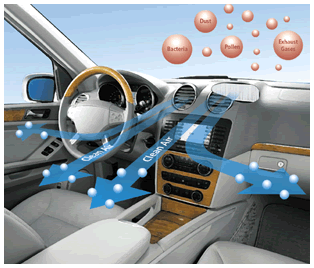
Again, many car owners probably don’t even know that a cabin air filter even exists, let alone that it needs to be changed.   Just like at home, the air filter is an essential part of your ventilation system that removes pollutants from the air before you breathe them in.  Years ago, they were designed to prevent solid particles like soot and dust from circulating in your car.  Today with the advancement of technology, air filters also can absorb gases and odors.  You may have heard cabin air filters referred to as dust filters, interior ventilation filters or even pollen filters.

Unfortunately air pollution is a fact of life.  If you drive often, and perhaps mostly on major highways during rush hour, without the air filter, you will breathe air that contains exhaust fumes, dust and soot, which obviously isn’t good for your health.  The air filter prevents those pollutants from entering your Buick or GMC, and allows you to breathe cleaner air.

Watch this video which explains more about car cabin air filters and why & how they’re changed.

If you still aren’t sure how to change your cabin air filter. Just swing by Freeman Grapevine and we can help you out.

Debunking Common Maintenance Myths

GMC Dallas, Buick Dallas, Used Cars Dallas, Texas GMC, Used Cars Fort Worth, Used Car Dealers Dallas, Texas Buick, Texas GMC DealerIt seem that debunking myths has become one of my favorite things to do lately. If you’ve kept up with Dallas GMC Dealer, Freeman Grapevine, you know that I’ve touched on gasoline myths and electric car myths recently. In continuing with this little series I’ve started, I want to share my favorite cars myths of all –maintenance myths. I think these are my favorite because they are the most common. They’re also the most important because you may think you are doing what’s best for your car when in reality, you might be compromising your safety and your wallet. That being said, let’s not waste anytime.

Maintenance Myths


Myth: Engine oil should be changed every 3,000 miles.
Reality: Despite what oil companies and quick-lube shops often claim, it’s usually not necessary. Stick to the service intervals in your car’s owner’s manual. Under normal driving conditions, most vehicles are designed to go 7,500 miles or more between oil changes. Changing oil more often doesn’t hurt the engine, but it can cost you a lot of extra money. Automakers often recommend 3,000-mile intervals for severe driving conditions, such as constant stop-and-go driving, frequent trailer-towing, mountainous terrain, or dusty conditions.

Myth: Inflate tires to the pressure shown on the tire’s sidewall.
Reality: The pounds-per-square-inch figure on the side of the tire is the maximum pressure that the tire can safely hold, not the automaker’s recommended pressure, which provides the best balance of braking, handling, gas mileage, and ride comfort. That figure is usually found on a doorjamb sticker, in the glove box, or on the fuel-filler door. Perform a monthly pressure check when tires are cold or after the car has been parked for a few hours.

Myth: If the brake fluid is low, topping it off will fix the problem.
Reality: As brake pads wear, the level in the brake-fluid reservoir drops a bit. That helps you monitor brake wear. If the fluid level drops to or below the Low mark on the reservoir, then either your brakes are worn out or fluid is leaking. Either way, get the brake system serviced immediately. You should also get a routine brake inspection when you rotate the tires, about every 6,000 to 7,000 miles.

Myth: Flush the coolant with every oil change.
Reality: Radiator coolant doesn’t need to be replaced very often. Most owner’s manuals recommend changing the coolant every five years or 60,000 miles. Of course, if the level in the coolant reservoir is chronically low, check for a leak and get service as soon as possible.

Myth: After a jump-start, your car will soon recharge the battery.
Reality: It could take hours of driving to restore a battery’s full charge, especially in the winter. That’s because power accessories, such as heated seats, draw so much electricity that in some cars the alternator has little left over to recharge a run-down battery. A “load test” at a service station can determine whether the battery can still hold a charge. If so, some hours on a battery charger might be needed to revive the battery to its full potential.

Myth: Let your engine warm up for several minutes before driving.
Reality: That might have been good advice for yesteryear’s cars but is less so today. Modern engines warm up more quickly when they’re driven. And the sooner they warm up, the sooner they reach maximum efficiency and deliver the best fuel economy and performance. But don’t rev the engine high over the first few miles while it’s warming up.

Myth: Dish washing and laundry detergents make a good car wash.
Reality: Detergent can strip off a car’s wax finish. Instead, use a car-wash liquid, which is formulated to clean without removing wax.

Source: Consumer Reports

Heard of at least one of these before? I knew it. I’m sure some of you may be in shock right now realizing that all of you’ve known about DIY car maintenance has been wrong, but don’t fret Freeman Grapevine has you totally covered. You should never hesitate to give us a call with any car maintenance questions or any questions about cars in general. After all, we want to ensure your car lives the longest and healthiest life that it can.

timing belt, weakest link

Do you know what the weakest link in your Car is?

timing belt

That’s right, your car could have weak link. Now, you may not know anything about your new car other than the color and how to position the mirrors, so you’ll just have to believe me when I tell you that…

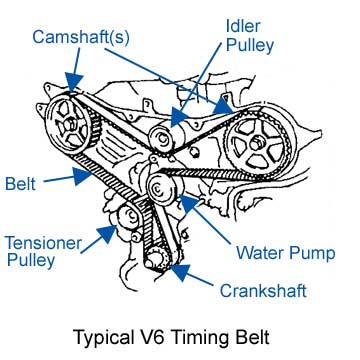
YOUR TIMING BELT IS THE WEAKEST LINK IN YOUR ENGINE!

Too Extreme? Well, maybe if your engine has less than 100,000 miles on it. However, the mere mention of its name should fill you with spine tingling fear. Why? A worn timing belt will quickly deteriorate into a BROKEN timing belt which could then result in catastrophic engine damage. Of course, if you don’t mind being a full time pedestrian, then you can keep thinking that belts are just for holding your pants up and continue on to the next post.

Timing belt service is not inexpensive and trying to save money going for the lowest bidder can be a prelude to disaster. I suggest using top quality parts, done by a mechanic that knows your type of vehicle. They will know if there are common faults that prevent the service from lasting through another full service cycle. Hmmmm, I wonder where you can find such a mechanic (Hint: Freeman Grapevine).

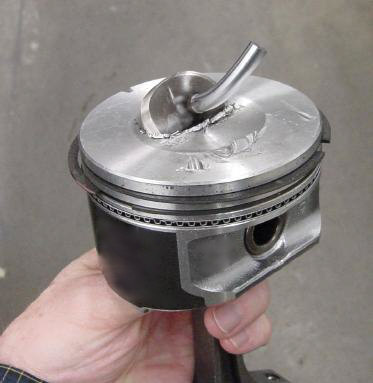
SPOILER ALERT!Typically, thousands upon thousands of dollars in damage is done when a timing belt fails. Many times the engine is destroyed.

Don’t believe me? Watch this!

httpv://www.youtube.com/watch?v=DGh-3fvK61I

Even though your car is new, remember, the weakest link is the one that takes the rest with it. That’s just one of the reasons you follow the manufacturers recommended mileage intervals for timing belt replacement, so an experienced mechanic can inspect the timing components to ensure they ALL can keep on driving with confidence.

How much does Timing belt service cost? While the cost for timing belt service has a wide range depending on model and components required. The basic timing belt service on most four cylinder vehicles starts at around $300.00.

Be sure to read your owner’s manual for your actual mileage to have your timing belt looked at.

Does anyone have any timing belt horror stories?

How’s Your Timing with Changing your Timing Belt

Q: What’s one of the worst things that can happen to your engine?

A:  Really poor “timing” changing your timing belt.

Let’s say that your vehicle is roughly 6 years old. You’ve never had any issues mechanically and as far as you are concerned, the engine purrs like a kitten. You may even pop your hood every now and then to tug on your fan belt, fill your wiper fluid, heck, maybe you can even change your own oil. However, there is a engine killer that lurks in the dark that rarely gets checked or is even remembered. It’s your timing belt.

Here’s the rub when it comes to changing your timing belt at the manufacturer’s prescribed intervals. Let’s say, for years your car has just been the perfect vehicle. Until one day you are cruising along and the engine suddenly goes dead silent. Guess what? Your vehicle’s timing belt failed!

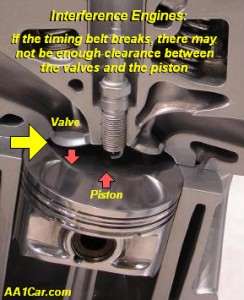
Now is when the real pain starts. Not only do you have to pay for the tow and the belt replacement, but also a costly valve job due to the damage the broken timing belt has caused. You’re one of the unfortunate car owners with an “interference engine” …A What?– That is an engine that can leave one or more valves still propped open far enough to contact a piston with valves and the belt parts. Sadly, car sales brochures don’t list whether or not an engine might suffer catastrophic damage if the belt goes. But trust me…a broken timing belt will leave you with considerable more expenses. In fact, you might have to replace your engine all together.

Check out the video below for more…engine terror:

httpv://www.youtube.com/watch?v=DGh-3fvK61I

So, as you can see the mere act of reading your owners manual and paying better attention to your maintenance schedule can save you from making a costly mistake of omission. Remember, in most cases, the broken timing belt unpleasantness could have been prevented with timely maintenance. I can’t say this enough: Replace the timing belt according to your vehicle manufacturer’s recommended schedule. It’s just that easy.

If you’d like to avoid a catastrophic engine seizure or your manual (hint, hint) says it’s time for a change. Don’t wait. Call me so I can save you time, money and all of the headaches that also come with a broken timing belt.

Do you know how to handle a tire blowout?

If you’ve never experienced a tire blowout, let me just tell you that it’s beyond scary. This is especially true if you don’t know how to handle the vehicle in this situation. There are several reasons a tire may blow out. The two most common reasons have to do with the air pressure.  Too low of pressure causes the tire to flex more than they are designed to, and if the pressure if too high, the tires a stressed beyond the designed limits.

The easy way to avoid a blowout, is to check your tire pressure at least once month (especially during the summer). However, checking the tire pressure is not a sure-fire way to avoid a blowout. There could be a defect in the tire itself or the wheel, in which case you’d be none the wiser.

The best thing I can suggest to you is to be prepared. Know what to do and what to expect when it happens.

Step 1: Stay cool.

Ignore your natural instinct to hit the brakes or jerk the steering wheel when you have a blowout.

Step 2: Accelerate slightly.

Accelerate slightly to maintain control of the vehicle. Keep going straight.

Tip: Hold the steering wheel firmly with both hands at 10 o’clock and two o’clock on the wheel to avoid losing control.

Step 3: Decelerate.

Ease off the accelerator slowly.

Step 4: Coast.

Maintain your course while the vehicle slows.

Step 5: Apply brakes.

Apply the brakes gently when your car slows to 30 miles per hour.

Step 6: Turn on right turn signal.

Tip: Never stop on the left side of the road, if possible. This is the most dangerous place to be.

Step 7: Pull over.

Pull your vehicle off to the side of the road, and breathe a sigh of relief…you’ve just survived a blowout.

[How Cast]

httpv://www.youtube.com/watch?v=k5kq101nYSU

Rain, Rain go away save your hail damage for another day!

Pretty clever title, huh?

Living in Texas, we are all too familiar with “Texas Weather”. To put it simply, it can and usually does change on a dime. Nice and sunny one moment and the next you are being pelted by penny to softball sized hail. I’d go as far as to say that the “Hail Sale” was invented here in Texas.

So what do you do of your poor new car gets pelted by an unexpected deluge ice nuggets and ends up looking like a golf ball? One of two things. You can watch the video below for a look at what it takes to get your ride back to it’s unblemished self. It shows the tools you’ll need and how you might want to go about prepping your dent removal project.

To keep it interesting, they challenged the tech to do 6 dents in under a minute. As a novice, I’d plan for a much longer amount of time for your project. Also keep in mind that this is just the hood. Chances are if you’ve sustained hail damage it will probably be on your roof and trunk as well…as this point, I’d really consider bringing it in to have a professional take a crack at it.

Check out the video:

httpvh://www.youtube.com/watch?v=TGFk-gJsT8w

As you can see, if you know what you are doing, restoring your car after a hail storm takes a little patience, the right tools and some mechanical ability (removing hoods, liners, paneling etc.).

If you’ve sustained any hail damage (it’s crazy weather season in Texas) and don’t want to tackle a dent removal project yourself, then don’t hesitate to give me a call and I’d be happy to help you get your pride and joy back too showroom condition.


Diagnose the 9 Most Common New Car Electrical Problems

I know, “It’s a new car, how can it have electrical problems?” Well, either that new car probably really isn’t as new as you think, or you have a valid issue. So, how can you tell the difference and what do you do about it?

The electrical systems in new cars have definitely made driving a lot easier over the decades. The seemingly endless innovations in electrical systems have helped us enjoy a more comfortable and easier drive. However, for every Yin, there’s a Yang.

Yin & Yang

Let’s say, you have problems starting your car and notice other problems with the electrical system. Let’s cover some of the issues that you could face with your new  vehicle’s electrical system:

Common Automobile Electrical System Problems Are : Car’s Battery Is Dead – This is the most common problem…and most obvious. Check your battery by engaging your headlights and judge by the illumination.

No Power Stored in the Battery – When you turn the key, what do you hear? A little click? Does it sound like it want’s to turn over? It is possible that your car’s battery does not have ample power to crank the starter. You need a new battery.

Alternator is Not Working – A damaged or broken alternator could be the culprit. No alternator? No battery recharge. If your car suddenly start to lose “juice” while drive, you’ll know it could be your new car’s alternator.

Problem with Starter or Solenoid – Good parts gone bad parts. If it’s the starter, it won’t turn over. If you have Solenoid issues, you might find it harder to brake.

Battery Cables Might Be The Problem – A loose cable might be the root of the problem…give them a wiggle before you run out and buy a replacement.

Electrical Fuses – Check for any blown fuses in your fuse box. Also, feel around for any loose wires.

Cracks In Alternator Belt – Too much or too little tension, as well as cracks in the alternator belt cause trouble.

Ignition System Has Problems – You have a busted ignition switch. Give your mechanic a call.

Loose Spark Plugs – Loose or old plugs will certainly affect the operation of your vehicle. Are you loosing power as gears change? Does it lurch as if the gears aren’t engaging? It might be the internal combustion and the culprit is usually the plugs and cables.

Now these are just guidelines you can crosscheck any issue you might have experienced. I you can talk with your mechanic about your new car logically by doing a little research, you help him help you even faster. If you have any questions, or you might think that you might need a great mechanic, I know where to find one.

Don’t discard that dead battery…charge it!

https://www.flickr.com/photos/lanevids/14450482251/in/photolist-o1WuVH-6nkb3V-5JFhxc-5JFfRD-azU9eb-5JFin8-5JKxe5-5JKvxL-5JKuQA-5JKtVJ-5JKt4Q-4hBYuv-dmB7dm-57dKoN-qQyF7W-9MdLMX-amFehK-86ugqZ-BVBz1-aeRqTt-cvZRoE-6cNj6x-nzm8TT-nxjkY9-5hBnY7-8oFrFa-8oJBBb-6eGwep-7gNszJ-7vYYq-gSDzHJ-6cucrh-Zfro2-BZEv8-ELTjf-PnLoc-e6z9Nk-62NUa1-fCRZs-55LGPr-6NbXh-8N8cwz-nhs5E1-2adYES-2a9AgK-4RfZr3-6s5RN4-7818ai-aCjWxX-dSQdhg
Lane Fournerat/Flickr Creative Commons

How important is it to keep a well maintained battery under your hood? Let’s call it your car’s Cup ‘o Joe…it provides that little boost in the morning when you turn the ignition to get the motor runnin’ (among a myriad of other tasks).

So, let’s say you accidentally left your interior lights on all night and you wake up to find that you have a dead battery, what do you do? Without a battery charger, you call into work and burn a personal day in hopes of getting a jump from a neighbor or a new battery. With a battery charger, well you get to save that personal day for a time when you really want to play hooky. Let me tell you, for around $50, it’s worth it and you’ll get a pretty decent charger to boot!

How does a charger work? Check out the video.

httpv://www.youtube.com/watch?v=JEPuO8kZVE8&feature=player_embedded

How easy is it to use? This easy.

httpv://www.youtube.com/watch?v=0oSuz0T51Fs&feature=player_embedded

Of course, there could also be other reasons why your battery is discharging faster than usual or not having enough juice to turn the starter, and that is a bigger issue. I’d advise you take your car to your mechanic if your battery issues become problematic.

Improve Your Windshield’s Visibility

So….When was the last time you changed your wiper blades? 2 years? Then you’ll want to watch this. If you don’t know where your Wiper blades…get a bus pass.

httpv://www.youtube.com/watch?v=cJN7NqkUd1k

…or, you can always go the Red Green way of getting the most out of your windshield wiper components.

httpv://www.youtube.com/watch?v=jlS-hN6EmIA

If you can’t bring yourself to stop at an auto parts store to buy new blades, then the next time you are in for service, make sure you get you wiper blades changed. In all seriousness, this will really improve your visibility, especially at night as poor blades tend to leave streaks and make the headlights from on coming traffic even more of an annoyance than they already are.

Need help? Swing by my place!