Tag Archives: GMC

GM’s move to Woodward is the right one — for the company and for Detroit

Filed under:
,,,,

Continue reading GM’s move to Woodward is the right one — for the company and for Detroit

GM’s move to Woodward is the right one — for the company and for Detroit originally appeared on Autoblog on Wed, 1 May 2024 10:19:00 EDT. Please see our terms for use of feeds.

Permalink | 
Email this | 
Comments

These 10 car brands get the most speeding tickets

A couple of years back, Insurify, the big insurance clearinghouse, conducted a study listing the car models that get the most speeding tickets. Of course, to paraphrase the gun industry, car models don’t get speeding tickets, people get speeding tickets, now don’t they? Or rather, people who are attracted to those particular car models get speeding tickets, so maybe the models do have something to do with it after all. Drivers, the study said, are “living up to their vehicles’ reputations.”

Percentage of drivers with a speeding ticket, by model:

  1. Subaru WRX, with 18.8% of drivers showing at least one speeding ticket
  2. Hyundai Genesis Coupe, 17.7%
  3. Kia Stinger, 16.6%
  4. Mazda3, 16.4%
  5. Subaru BRZ, 16.2%
  6. Scion FR-S, 16%
  7. GMC C1500, 15.3%
  8. Volkswagen GTI, 15%
  9. Subaru Impreza, 14.8%
  10. Hyundai Veloster, 14.7% 

Compare those numbers to the national average, in which a hair under 10% of drivers overall have had a speeding ticket. And note that Subaru, the brand that loves kids, dogs and safety, is the standout here, with three models on the list.

Now, turn the clock forward two years to 2023, and Insurify has conducted a similar study, this time ranking car brands that rack up the most speeding tickets. When you’re talking about an entire brand rather than specific hot models like the WRX or Genesis Coupe, you get a different picture. 

Percentage of drivers with a speeding ticket, by brand:

  1. Infiniti, 8.7%
  2. Scion, 8.4%
  3. Volkswagen, 8.3%
  4. Subaru, 8%
  5. Mazda, 7.7%
  6. Audi, 7.6%
  7. Kia, 7.6%
  8. Honda, 7.5%
  9. BMW, 7.4%
  10. Hyundai, 7.4%

The national average across all brands is 7.1%. How did Insurify come up with this information? It’s gleaned from 4.6 million applications for car insurance. One factor not made clear in the methodology is how far back in one’s driving record this assessment goes: You may have a speeding ticket on your record from a year or five years ago that gets noted when you’re buying insurance on the WRX you just bought today.

Some other tidbits from this study:

  • The brand study has one curious mention: By 2023, a newcomer had leapt up the list of car models that get the most tickets, and it’s one you definitely didn’t see coming — the BMW i3, with 17.6% of its drivers racking up speeding tickets. There was no explanation for why the heck that might be, other than it’s nimble and fun to drive. Meanwhile, Z4 drivers are just cruising the boulevard and enjoying the sunshine, with 4.5% cited. 
  • The car brands with the least-speeding drivers are Cadillac, at 5.4%; Tesla, at 5%; and Volvo, at 2.7%.
  • The Subaru Ascent really pulled down the Subaru brand average, offsetting all those WRX tickets. Only 1.9% of Ascent drivers have had a speeding ticket.
  • Cops make 20 million traffic stops a year, and 43% of those are for speeding. So over 8 million Americans each year are getting speeding tickets, or at least a warning. And with good reason: Speeding is a factor in nearly a third of all traffic fatalities.

These are the most expensive vehicles to gas up

Complaining about gas prices has been a thing for as long as anyone can remember, even when they were just a fraction of the tremendous numbers we see today. While it’s true that gas prices are more oppressive now than ever before, the reality is that the vehicle you drive is one of the biggest factors determining how much you’ll pay for fuel. Consumer Reports recently outlined the most expensive cars to fill up a tank of gas (cars being a misnomer as these are big trucks and SUVs). There are few surprises on the list.

Despite moving to a smaller engine and an available hybrid with the latest update, Toyota didn’t do much to improve the full-size Tundra’s fuel costs. Consumer Reports estimated the average fuel cost to fill the tank at $118, making it the most expensive model on its list.

The 10 vehicles that are most expensive to fill up:

  1. 2024 Toyota Tundra: $118 per tank
  2. 2024 Ford Expedition: $102
  3. 2024 Chevrolet Suburban: $103
  4. 2024 Nissan Armada: $96
  5. 2024 Infiniti QX80: $96
  6. 2024 Nissan Titan: $96
  7. 2024 Ram 1500: $96
  8. 2024 Cadillac Escalade: $88
  9. 2024 Chevrolet Silverado 1500: $88
  10. 2024 Chevrolet Tahoe: $88
  11. 2024 Toyota Sequoia: $83

Gas costs were estimated using AAA’s national average of $3,68 a gallon on April 22. While many models on the list certainly could use a boost in fuel economy, most also have large fuel tanks, making them more expensive to fill either way. It’s also important to note that you may see extreme fueling costs for models not included here, as many require premium fuels to function properly.

The good news is that there’s plenty you can do to save money at the pump. Consumer Reports recommends driving smoothly and obeying the speed limit. You might also look at club stores like Sam’s Club or Costco, which often have discount programs for members. Finally, many gas brands offer credit cards and other programs that save a few cents per gallon, but you may be tied to that company’s stores to get the savings.

Buick Electra-L, Electra-LT concepts lead the Wildcat to production

Filed under:
,,,,,,

Continue reading Buick Electra-L, Electra-LT concepts lead the Wildcat to production

Buick Electra-L, Electra-LT concepts lead the Wildcat to production originally appeared on Autoblog on Fri, 26 Apr 2024 14:10:00 EDT. Please see our terms for use of feeds.

Permalink | 
Email this | 
Comments

These are the slowest-selling new cars of 2024

Filed under:
,,,,,

Continue reading These are the slowest-selling new cars of 2024

These are the slowest-selling new cars of 2024 originally appeared on Autoblog on Fri, 26 Apr 2024 10:00:00 EDT. Please see our terms for use of feeds.

Permalink | 
Email this | 
Comments

These are the 10 worst U.S. cities for driving in 2024, ranked

How’s the commute where you live? Chances are, it’s not as bad as the daily drives experienced by people living in Oakland, Calif., or Miami, Fla. A new study from Forbes Advisor outlines the worst cities in the country for driving, and some of the names on the list likely won’t come as much of a shock.

The 10 worst U.S. cities for driving:

  1. Oakland
  2. Miami
  3. San Francisco
  4. Houston
  5. Philadelphia
  6. New York City
  7. Chicago
  8. Atlanta
  9. Dallas
  10. Portland, Ore.

Forbes ranked 47 metro areas by comparing data for 15 metrics that were grouped into four basic categories: driving experience, safety, cost of car ownership and access to car maintenance.  The study assigned points for gas prices, insurance rates, commute times and even weather to rank U.S. cities. While Oakland took the “top” spot overall, Boston was the worst for driver experience specifically, and Albuquerque was the worst for driver safety. New York City is the most expensive place to own a car, and drivers in Memphis have the worst access to car maintenance.

Looking through the lens of gas prices, it’s not surprising to see that two other California cities landed in the 20 worst for driving, including Los Angeles and Long Beach. According to AAA, the state’s average gas price today is $5.42, significantly higher than the $3.667 national average.

Drivers in the worst cities spent long periods lost in traffic congestion and had low average speeds during rush hour traffic. They also had longer drive times to travel six miles, and their downtowns had the lowest average speeds. Forbes included weather in its study, looking at the average number of days with precipitation, which can bring out the worst in even the most experienced drivers.

These cities also had poor showings for insurance rates. Drivers living in congested urban areas where accidents are common pay more for car insurance because of the greater risk associated with where they drive most often. These areas may also have higher rates of uninsured drivers and more injuries associated with crashes, driving up the costs for insurers, who always pass those costs onto customers.

For a deep dive into the rankings, the methodology behind them, and to see the full list of cities and an interactive map, check out the full report.

What is Flex Fuel? The pros and cons of flexible fuel vehicles

On the surface, Flex Fuel sounds like a great idea. Certain cars that are designed for it can run on a variety of blends of gasoline and ethanol. OK, we all know gasoline, but what is ethanol then? It is a type of alcohol derived from crops like corn or sugarcane. Ethanol fuel came about as a response to oil shortages, starting in the 1970s, and eventually became an important market for grain farmers. Flex Fuel engine technology didn’t really mature until the 1990s, and automakers, mostly the Big Three, began introducing flexible fuel vehicles.

What is Flex Fuel?

Specially equipped vehicles designated as Flex Fuel capable can operate on E85, a mix that can contain from 51% to 83% ethanol and just the remainder as gasoline. However, to a lesser degree, nearly all modern cars are already using a gasoline-ethanol mix. Most gasoline sold at pumps in the U.S. could technically be E10, a 10% ethanol blend, though it isn’t always.

The EPA has also approved E15, a 15% ethanol blend. However, in 2012 a coalition of automakers pushed back against the proposal to increase ethanol content by 50%. The EPA deems E15 safe to use in 2001 and newer cars, but there has been conflicting research on whether or not it is damaging. Many automakers said at the time that they would not honor warranties if owners used E15.

Flex Fuel pros

By stretching the amount of actual gasoline used, Flex Fuel seems like the perfect solution for extending a finite resource and reducing dependence on foreign oil. And since the ethanol was derived from renewable biomass, it was originally seen as a green solution as well.

In addition, E85 has an octane rating of about 110, higher than the 93 octane of premium fuel. That means the fuel can better resist earlier-than-expected combustion caused by compression and thus burns more completely, and a cleaner burn means fewer emissions at the tailpipe. While performance engines typically have higher compression ratios, the current crop of E85-compatible vehicles are not exactly sporting machines that can take advantage of the higher octane.

Because Flex Fuels use less petroleum, they are cheaper. At the time of this writing, the national average for E85 is about 80 cents less than E10, the most common type of fuel. Prices will vary by region, so check your local listings.

Flex Fuel cons

It may seem like a no-brainer to use E85 if you have a Flex Fuel vehicle in times of high gas prices. However, it should be noted that ethanol reduces fuel economy (miles per gallon) by as much as 25% to 30%. Depending on the vehicle’s mpg rating and the local price of E85, drivers will have to determine for themselves whether the reduced fuel economy negates any potential savings at the pump.

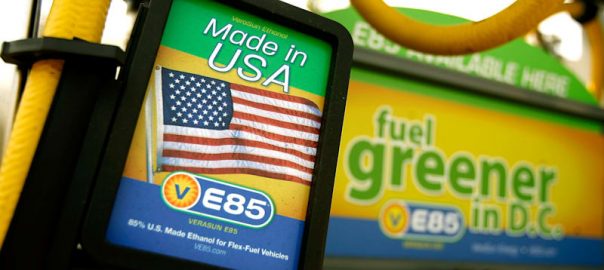
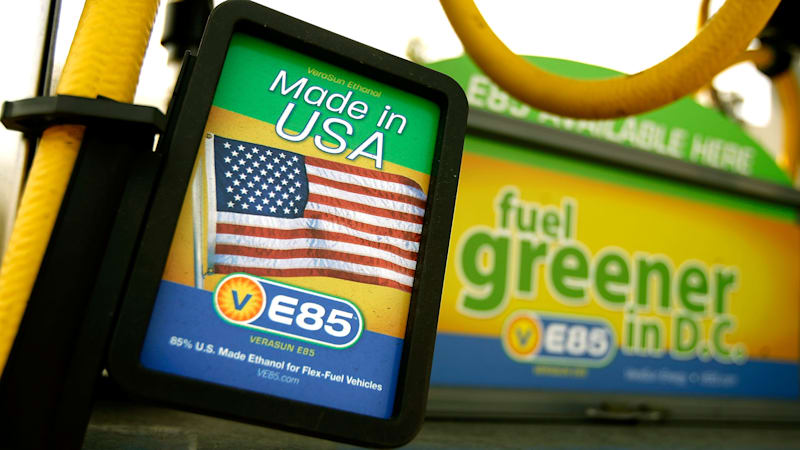
Perhaps an even bigger problem is that E85 might not even be as great for the environment as proponents claim. In the U.S. most ethanol is derived from corn, and the corn industry has an immensely powerful lobby. Filling stations in states like Iowa, where corn is a major industry, have a lot more E85 available, often with stickers touting its claimed environmental benefits.

Over the years, powerful corn lobbyists have won a lot of government subsidies, which in turn prompted many producers to grow the crop even though, according to a Stanford University study, corn-based ethanol is five to six times less efficient to produce than sugarcane-based ethanol.

Another study in the Proceedings of the National Academy of Sciences found that after taking into account the increased clearing of land to grow corn for ethanol production, the environment would be better off if cars just burned straight gasoline. And then there’s the fact that we’d be better off using the resources corn takes up to grow crops that feed actual people. Ethanol would be most beneficial if it could be economically made from biomass that would otherwise be discarded, like corn stalks and other cellulosic sources.

How to identify a Flex Fuel vehicle

Flex Fuel vehicles are designated by either a yellow fuel filler cap or a yellow ring on capless fuel tanks. They may also have labels on the inside of fuel filler doors, or special Flex Fuel badging on the vehicle. The U.S. Department of Energy offers a list of Flex Fuel vehicles on sale right now. Most are workhorses like the Chevy Silverado/GMC Sierra, Ford Transit Connect, Transit, F-150 and F-250. The Ford Explorer is the only standard family car currently on the list, though you can find some older, discontinued Flex Fuel cars on the used market like the Chevy Impala and Ford Taurus.

Should I use Flex Fuel?

If your vehicle wasn’t built as a Flex Fuel vehicle, do not use E85. The high ethanol content will damage vital engine parts and the fuel system. As we mentioned above, it’s probably best not to risk using E15 if you have an older vehicle or are unsure if it’s compatible in your car.

Does ethanol damage cars?

Many sources, including the U.K.’s Royal Automobile Club, say that even E10 can be damaging to cars older than the 2002 model year. Ethanol is corrosive, and its use can damage fuel systems that weren’t designed for anything other than pure unleaded gasoline. Fuel tanks, gaskets and seals, and other rubber or plastic components could all be subject to damage.

It’s not a guarantee of damage, and how susceptible your vehicle is will likely depend on the age and model. If this is a concern for classic car owners, they can either use an ethanol conditioner and stabilizer or find one of the few remaining gas stations that offer ethanol-free fuel.

Finally, gasoline blends containing ethanol are widely regarded in the boating industry as potentially damaging to outboard motors, especially two-stroke motors.

Related video:

.embed-container { position: relative; padding-bottom: 56.25%; height: 0; overflow: hidden; max-width: 100%; } .embed-container iframe, .embed-container object, .embed-container embed { position: absolute; top: 0; left: 0; width: 100%; height: 100%; }

The 10 car brands most expensive to maintain over 10 years

Car maintenance has got to be one of the least fun things you can do with your free time, right behind going to the dentist and filing your taxes. However, depending on the brand you buy, your time spent at the shop could be much more than you bargained for. Consumer Reports’ new study on the most- and least-expensive-to-maintain car brands found that European car companies are most likely to break your wallet with costs nearly five times that of the automakers at the other end of the spectrum.

Land Rover had the highest ten-year maintenance costs, at an average of $19,250. Porsche was second worst with $14,090 in costs.

10 car brands most expensive to maintain over 10 years:

  1. Land Rover: $19,250
  2. Porsche: $14,090
  3. Mercedes-Benz: $10,525
  4. Audi: $9,890
  5. BMW: $9,500
  6. Volvo: $9,285
  7. Infiniti: $8,500
  8. Acura: $7,800
  9. Mini: $7,625
  10. Subaru: $7,200

The Euro brands at the “top” of this list aren’t all that surprising. Land Rover has consistently landed as one of the most expensive vehicle brands to maintain for years now, though Porsche is generally viewed as being one of the more solid performance brands. That could suggest that some models don’t always require more repairs, but the fixes they do need are significantly more expensive.

Tesla, Buick, and Toyota were the three cheapest to maintain car brands, with 10-year maintenance costs of $4,035, $4,900, and $4,900, respectively. Consumer Reports noted that these numbers could be slightly skewed due to the fact that some automakers offer free maintenance for the first few years of ownership, and all companies cover their new vehicles for at least a few years after the purchase.

Routine maintenance is a great way to avoid costly repairs over time, as it’s much cheaper to catch a problem before it starts causing other issues. Check your oil, rotate your tires, and avoid driving like a wild person, and you’ll likely fare much better than others, even if you own one of the scarier-to-maintain brands.

The 10 car brands cheapest to maintain over 10 years

Buying a car can be fun and bring a lot of freedom, but things can go sideways when it comes time for repairs. Some car brands are better than others, however, and Consumer Reports recently ranked the least- and most-expensive brands for owners to repair. There are few surprises on this list, but the cheapest new car and the runner-up might come as a shock. Tesla and Buick were the cheapest new car brands to maintain and repair over 10 years, followed by Toyota, Lincoln, and Ford.

10 car brands cheapest to maintain over the next 10 years:

  1. Tesla: $4,035
  2. Buick: $4,900
  3. Toyota: $4,900
  4. Lincoln: $5,040
  5. Ford: $5,400
  6. Chevrolet: $5,550
  7. Hyundai: $5,640
  8. Nissan: $5,700
  9. Mazda: $5,800
  10. Honda: $5,850

Consumer Reports noted that maintenance costs for some brands can look deceiving, as many offer free maintenance for a period after the purchase. New-car warranties also play a role, with the powertrain coverage spanning four or five years and 50,000 or 60,000 miles, depending on the company. It’s also worth noting that Tesla only sells EVs, which don’t require engine air filters, oil changes, and some other routine maintenance, lowering their average costs.

Related:

The most expensive brands to maintain might not come as a surprise, but the costs associated with owning them might. Land Rover was the worst, at $19,250 over 10 years, while Porsche came in second at $14,090. Mercedes-Benz’s average costs were $10,525 and Audi’s $9,890. While this suggests that these brands need more frequent repairs over the 10-year period, it also points to higher labor and parts costs for the European automakers.

If you own one of the more expensive brands to maintain and you’re worrying as you read this, there are a few things you can do to prolong your vehicle’s life and minimize unnecessary maintenance costs. The first is to follow the automaker’s suggested maintenance periods, changing your oil, rotating tires, and doing all the “boring” stuff before it becomes a problem. It’s also a good idea to take care with the way you drive, avoiding potholes, accelerating gently, and trying not to abuse your brakes. Finally, don’t modify your vehicle. Car companies spend billions on research and development, and most know better about how a vehicle is meant to operate than you do in your garage with third-party parts.

Next-gen GMC Terrain teased looking chiseled in AT4 trim

Filed under:
,,,,,

Continue reading Next-gen GMC Terrain teased looking chiseled in AT4 trim

Next-gen GMC Terrain teased looking chiseled in AT4 trim originally appeared on Autoblog on Thu, 18 Apr 2024 10:00:00 EDT. Please see our terms for use of feeds.

Permalink | 
Email this | 
Comments