Category Archives: Used Cars

Is horn honking protected free speech? The Supreme Court to decide

Did you know that in some states a friendly tap on the car horn celebrating a sports team or just for saying “I’m here” or “goodbye”, can be illegal? The U.S. Supreme Court will soon decide on an odd car-related case: whether honking a car horn as a show of support is protected by the First Amendment of the Constitution.

The case began in 2017, when 69-year-old Susan Porter of Oceanside, California, honked to show solidarity with protesters outside the office of her local congressman. She was immediately issued a ticket by a sheriff’s deputy. 

“He said, ‘illegal use of horn’ and gave me the ticket,” Porter told USA Today

The California vehicle code states that the only two legal uses of a car horn are to give an audible warning to another driver, and as part of an anti-theft device. However, the law is rarely enforced and the practice of honking situations that fall outside those narrow definitions is widespread. In fact, Porter’s case was dismissed in California’s traffic court when the deputy issuing the ticket failed to appear.

However, Porter decided to file a civil suit, arguing that the use of a car horn should be protected free speech under the First Amendment. Both a California District Court and U.S. Court of Appeals for the Ninth Circuit ruled against Porter in the state of California’s favor, leaving Porter no where to appeal but the highest court in the land.

In the San Diego Tribune Porter’s lead attorneys, Thaila Sundaresan and Andrew Row, argued that presidents Joe Biden and Donald Trump both encouraged their supporters to honk during their 2020 campaigns, which were run during COVID-19 lockdowns. 

“The pandemic showed that when restrictions are placed on gatherings, people use cars as extensions of themselves,” Row told the Tribune. This argument also makes a good case for manual transmissions, but we digress.

The National Constitution Center’s blog cites similar cases that have been decided in other states. In Montana and Washington in 1998 and 2001, respectively, state Supreme Courts decided against the honker in two cases where horns were used to show objection to neighbors during disagreements. In 1992 in Oregon, a case similar to Porter’s was decided in the favor of protesters who honked during anti-Gulf War demonstrations. 

The California case, Porter v. Martinez, will be part of the docket during the Supreme Court’s session starting November 27.

Best Thanksgiving car choices for every decade Thanksgiving has existed

It’s Thanksgiving week and with it comes the predictable sluggishness of the holiday news cycle and its corresponding boredom and restlessness. We’d had enough of it by Tuesday afternoon that Riswick turned (figuratively) to Hurd and said, “Hey, why don’t we throw some cars in a post and see what happens?” The creative process works in mysterious ways. Call it boredom, slot-filling or just old-fashioned strangeness, but Hurd managed to turn what would be a conventional “best family haulers” post into the historically confused mess you see before you with one simple idea: Let’s travel for Thanksgiving, but let’s do it while going back in time. No, not like in a DeLorean. But also, yeah, kind of. 

America has celebrated Thanksgiving since it was first declared in 1885, famously inspiring Karl Benz to build the first automobile a year later … in Germany. But in all seriousness, the official declaration of America’s thanksgiving did in fact coincide with the first automobiles scurrying about the compounds of oddball inventors and enterprising businessmen. So of course, we decided to pick our favorite (or most likely, or simply only) options for holiday travel over the past 140-ish years. Sound straightforward? Hardly. Hurd’s involved. And Riswick’s Canadian, so he’ll probably trot out some converted maple syrup hauler from the 1950s. Who knows? Grab some turkey and let’s dive in. It’s going to get weird. 

Today – The 2020s

Riswick: Toyota Sienna XSE

For this entire exercise, I’m going to be picking a new vehicle that can make my former annual Thanksgiving journey drive from Portland, Ore., to Simi Valley, Calif., about an hour outside Los Angeles. I’ll also be making the journey with my wife, 3-year-old son and two 20-pound dogs. We’ll be bringing lots of crap. As we’re just driving, without any need to venture off the beaten path or plug something into a trailer hitch, I’m going minivan all the way here. And since gas prices suck, I’m going with a hybrid. And since we’re talking about a 1,000-ish-mile journey, the plug-in-hybrid Pacifica isn’t as helpful. Ergo, Toyota Sienna XSE. It’s the sporty one, you know. The Super-Long-Slide second row is terrific for providing lots of space for my son to kick about in his chair without bothering us, as well as clearing away loads of floor space for my dogs’ giant dog bed. As it’s a Toyota from 2023, it also has adaptive cruise control (not the best one, to be fair) which is great for long highway journeys.

Hurd: Bentley Bentayga

My family and friends are bit more scattered than Riswick’s, so my choices are going to be a bit more … academic? While rules and structure are important, my reality (one partner, zero kids or traveling pets) allows me to slap “1990 Mazda Miata” into just about every challenge we do here. That may be fun for me in the real world, but it doesn’t contribute much to a discussion like this. So I’m going to play along … to a point. 

Since I don’t have any kids or dogs for my relatives to fawn over, I might as well roll up in something cool. The Bentley Bentayga has the awkward personality of a precocious teenager and costs about as much as middle-class college education, plus the little hole for electricity will surely get the family talking about the future of the automotive industry! Or at least get one or two crazy uncles going about how a 450-plus horsepower hybrid system is somehow proof that China has taken over America, even if Bentley is a British make owned by a German conglomerate.  

The 2010s

Riswick: Ford Flex EcoBoost

My favorite family vehicle of all time is the Ford Flex EcoBoost, so I’m going with that here. I took numerous road trips in a first-year version, including from L.A. to Vancouver, B.C., and loved it. And that didn’t have the 350-horsepower EcoBoost turbo-V6 that utterly obliterated the competition of the time … and actually today, as well. The Flex was a cool people mover that was also better to drive than contemporary large crossovers and usually more spacious than them as well.

Hurd: Cadillac CTS-V Wagon

Zero chance I’m passing up the opportunity to pick this beast, a Cadillac CTS-V Wagon. This is up there on the list of all-time coolest American cars — even among those who don’t own GM performance vehicles. And you folks who need a true family hauler can’t even get mad about this choice; it’s about as brood-friendly as my picks are going to get. Enjoy it while it lasts.  

2000s

Riswick: Range Rover

Good grief, why am I being so damned practical, here? We never said a word about budget, and yet here I am picking Sienna and Flexes while Byron’s rocking a Bentley and CTS-V Wagon. No more! Time to call up what is easily one of the best SUVs of all time, the 2000s-era Range Rover. It is perfection, at least until they needlessly futzed with the styling for the sake of futzing with the styling. No matter. Even then, it was a classic. I drove one once, resplendent in red with the supercharged post-BMW engine, from L.A. to Phoenix and it was divine. I think I’d want one of the earlier versions with the BMW V8, preferably in green.

Hurd: Mercedes-Benz R63 AMG

Hey, a Cadillac station wagon is immensely practical. Also, forget that Range Rover; can I have the house?

Anyway, I spent most of the ’10s road tripping in Ford Mustangs and Mazdaspeed3s, but in this alternate reality where I’m going over the proverbial river and through the woods, I’m going to try something Riswick might more readily approve of: a minivan. Just a casual Mercedes-Benz R63 AMG. In addition to AMG’s 510-horsepower, 6.2-liter V8, it was also available with in-car DVD entertainment, a reverse camera, iPod compatibility, navigation, panoramic sunroof, bi-xenon headlamps, and more. Not bad for nearly 20 years ago. 

1990s

Hurd: I’m keeping with my previous theme of practical German transportation. This time, a nice family sedan. Based on the video review I found above, it seems like an excellent candidate for long-distance cruising that is simultaneously capable of some light off-roading in a pinch. And it’ll shrug off mild traffic impacts to boot — perfect for the mean streets of the 1990s. Yep, I picked the Audi S8, but specifically this Audi S8:

Riswick: OK, so that made me LOL, Byron. As long as you pronounce it “Oddy” and request a nitrous system for reasons. Just don’t turn your back on that German guy.

Speaking of German guys, I too am sticking to Deutscheland, and will be returning to an old favorite: an E39 BMW 5 Series. Specifically, a 540i Touring wagon. Because it’s basically one of the best cars ever made. I probably could’ve just used one of these in each of the subsequent decades. Sure, the E39 came out towards the end of the ’90s, but it’s also the most obvious choice for awesome family transport.

1980s

Hurd: Lincoln Town Car

This one’s near and dear to my heart. My grandparents had a mid-80s Lincoln Town Car that was always our default loaner car whenever we visited, holidays or not. I can still recite the keypad code for virtually every combination the car allowed. Unlock the doors? Yep. Open the trunk? You betcha. Oh, and it had a 302 under the hood. It wasn’t fast, but it wasn’t slow either. Miss that car. 

Riswick: Audi 200 Avant Quattro

So I was fully prepared to choose some vast 1980s American wagon, but then I thought about the particulars of my once-annual-journey between Portland and Los Angeles and the fact I almost always ended up in some blizzard around Mt. Shasta and the state border. I don’t want to be driving a Country Squire in that. I suppose a Chrysler minivan would be vastly better due to its front-wheel-driveness, but that’s just not me. We’re going back to Germany, sorry. The Audi 200 Avant Quattro is super ’80s, super practical, and per the name, all-wheel drive. Not that I’d need it, but you could even get a third-row seat. A version of this was even driven by Timothy Dalton in “The Living Daylights,” so hey, James Bond car! 

1970s

Hurd: Jeep Wagoneer

OK, I’m clearly swinging back toward the practical side of things here, but that’s OK. My family has always been into Jeeps, and this is probably the closest I’ll come to an opportunity to flex my fetish in a challenge like this one. It’s no Wrangler, but the Wagoneer was certainly a family-hauling staple for decades. I’ll take mine with wood. 

Riswick: Oldsmobile Custom Cruiser

Damn it, definitely wish I hadn’t suggested you start going first back in the ’90s. Wagoneer would’ve been perfect. I guess I could go with a Range Rover instead, but I’ve already picked one. I’ve also picked too much German stuff. Time to go Land Yacht, bring along some chains and pray for that annual blizzard to not happen. The 1974 Oldsmobile Custom Cruiser seems like an appropriate choice, and as the brochure would attest, if we need to stop along the way and let my son play in a giant hole, it’ll be perfect for that.

1960s

Hurd: Ford Bronco

It may seem greedy of me to claim this one, but like the Town Car above, this was actually one of my family’s driveway ornaments daily get-around cars for three decades. We no longer have it (a sad story; but it went to a good home) but my grandparents’ ’67 Bronco was an absolute stud — a Robin’s Egg Blue Ranger package automatic with the 302 and air conditioning. And it was a Texas car to boot; zero rust. I would have looked good bringing the turkey home in that thing.

Riswick: Oldsmobile Toronado

Screw it, we’re packing light. I want something that’s cool and also front-wheel-drive: I want a 1968 Oldsmobile Toronado. Yes, it’s another Oldsmobile, but they didn’t call this site Oldsmoblog for nothing back in the ’80s. Oldsmobile is always the right choice and I love me some original Toronado. And hey, with the front bench seat, it’s a six seater, so exactly the same as my Ford Flex up there!

1950s

Hurd: Chevrolet Corvette

Swinging back toward practicality for a bit. After all, what other domestic car had lightweight, fuel-efficient fiberglass panels worth showing off to your friends and family in the 1950s? This hypermiling hero would be right at home next to today’s frugal performance hopefuls. Now I just need help pronouncing it. It’s cor-veetee, right? Sounds Italian. 

Riswick: Edsel Villager

Uh oh, we’ve departed my knowledge base, so I really have no clue what I’m talking about. I mean, I’ve picked an Edsel, for Ford’s sake. Nevertheless, a 1958 Edsel Villager painted teal seems like the sort of contrarian, outside-the-box family vehicle choice I could get behind.

1940s

Hurd:Jeep J-0110

 It’s a Jeep thing; you wouldn’t understand. Except in this case, I think you would. This “All-Steel” Jeep Station Wagon (official designation J-0110) looks like an absolute treat. The hardtop will keep all my gear dry and since it’s a Jeep, I know it can be counted on should I wander off America’s more-established roads and onto the rutted byways that made up most of the nation’s prewar infrastructure. There’s a reason cars looked like this back in the day; roads weren’t really roads yet. (Image credit: Jeep)

Riswick: Packard Station Sedan

I really like the sound of “Hey honey, let’s take the Packard!” so I’m going with that. Despite the name, the Packard Station Sedan was actually a “pseudo luxury station wagon” as described by Wikipedia. That sounds right up my alley. More from Wikipedia, it “used a combination of steel framing and body parts along with structural wood panels made from northern birch to crate a ‘woody’ station wagon-like car due to the growing popularity of them after World War II.” Basically, it was like all those revival woodies in the ’70s and ’80s, but with real wood appliques instead of vinyl. Wacky! I love it.

1930s

Hurd: Dodge Eight

I’ve owned one 8-cylinder Dodge, but it was a 2013 Challenger with a six-speed manual and a 6.4-liter Hemi. This is an entirely different animal, but like the Jeep I picked for the 1940s, it’s a hard top with real cargo space — things that mattered back when mud was still an obstacle the average driver needed to worry about on a daily basis. Torque digs you out! After it gets you stuck, at least. Perfect for going over rivers that don’t have bridges yet. (Image credit: Dodge)

Riswick: Citroen Traction Avant

Oh right, I really have to remember that I’m driving from Portland to Los Angeles in the time period in question. That’s getting a lot harder to do. While Interstate 5 was preceded by US 99, I have to imagine it wasn’t the best-kept road, especially in the Cascades. As such, I’m going back to front-wheel-drive, and specifically the world’s first front-wheel-drive mass-produced car, the Citroen Traction Avant. I’m honestly not sure if they sold these in the United States, but we’re in the Depression, I’m sure I could pay someone enough to get it into the country. 

1920s

Hurd: Ford Model T

This one tickles my personal fancy. I’m a big fan of midwest architecture, and nothing symbolized the early days of motoring wealth like an overwrought Tudor Revival mansion. This Model T “Tudor” hits both my architectural and automotive history fetishes. More to the point, it’s exactly the sort of car that would have been in the garage of my 1928 Tudor Revival home, which was built by a man who moved here in 1911 to work for Ford Motor Company. (Image credit: Ford)

Riswick: Pierce-Arrow Model 81 7-Passenger Sedan

While Mr. Bentley up there suddenly gets frugal to match his house, I’m gettin’ all Gatsby. Purely on the strength of having the greatest hood ornament ever, I’m going with a 1928 Pierce-Arrow Model 81 7-Passenger Sedan. Clearly the definition of “sedan” used to be different judging by this and my Packard. Again, this sucker is teal. It also has a manual transmission, so right up my alley. Will me and my family almost certainly plummet to our deaths after sliding off the road somewhere north of Yreka? Probably! But we’ll do so in style.

1910s

Hurd: Stutz Bearcat

With family in the Southwest, where there was virtually no road infrastructure back in the ‘teens, I want something that I know will get me there. Take this Stutz Bearcat, for instance. It’s more robust than a horse, which was really the most important aspect of any car bought before Ford made the automobile affordable for most Americans. This one is being driven between Texas and Arizona. (Image credit: Detroit Public Library)

Riswick: Southern Pacific 2472

My destination in California, Simi Valley, wasn’t really a town in the 19-teens, so I’m not even sure why I’m driving there anymore. Land holdings? Am I farm baron? There was a train depot, though, so I guess it’s time to abandon the automobile … well crap, I’ve just discovered that the Southern Pacific Railroad didn’t start running from Portland to Los Angeles until 1924. Maybe that would’ve been a better idea than the Pierce-Arrow. Too late! Judging by an antique map I found, we could take a train, but we’d have to change trains. And the locomotive pulling it would look like that up there. What kind of locomotive is it? How the hell should I know? I’m an editor at AUTOblog. Googling “Southern Pacific locomotive 1920s” is the best I can do.

1900s

Hurd: Electric Streetcar

In the Year of Our Ford, 1901, most of us were still getting around by means other than the automobile. Streetcars were hopping on the electrification bandwagon, which made them far easier and more flexible to operate. Developers ran them from their subdivisions to work sites and, eventually, to fanciful attractions built to keep ridership high once everybody had populated their neighborhoods. We owe the 20th century notion of the amusement park to the proliferation of street-running electric railroads, but they could get us to grandma’s just fine too. (Image credit: Detroit Public Library)

Riswick: Whatever the hell that is up there

At least I’m not the only one who’s had to switch to rails. 

Googles “Southern Pacific locomotive 1902” 

1890s

Hurd: General Electric Class LE-1

Electrification was a thing in the 1890s too, as it turns out, but the things being electrified tended to have more than four wheels. Allow me to introduce you to the General Electric class LE-1, With tunneling becoming a critical infrastructure move for railroads in the late 19th century, dealing with air quality issues became priority #1 for passenger rail travel. Enter the electric railroad, which helpfully kept its particulate emissions far away from the location where the power was being used — a strategy we still employ to great effect all over the world today. The Baltimore & Ohio Railway claimed the title of first electric rail line in the USA when it opened in 1895. (Image credit: Wikipedia)

Riswick: One of those ships up there. The second one, sure

Those rail journeys sucked, let’s give Option B a whirl. I’m sure we’ll need to stop in San Francisco and who knows where else. And I’m sure sea conditions are just peachy along the Oregon Coast in November. What’s the worst that could happen?

1880s

Hurd: 4-4-0 American

Nominally, cars existed in the 1880s, but unless you were the 19th century equivalent of Doc Brown (or retracing his steps in “Back to the Future Part III”), you didn’t have one in your carriage house. In fact, most people didn’t even have carriage houses, even if they were fortunate enough to own carriages. If you needed to travel long distances to grandma’s house, you were going by horse or train. The 4-4-0 American was the locomotive of the 1800s; in fact, the one pictured above was one of the two present when the transcontinental railroad was completed in 1869. Over the continental divide and through the woods — that’s how that song goes, right? (Image credit: Union Pacific)

Riswick: Chinese Junk bound for Shanghai

Sadly, as this is 1885, the Portland riverfront is an atrocious place to be and while awaiting our 1880s passenger ship to San Francisco, I was shanghaied, forced into becoming a sailor and died of scurvy. My wife, son and dogs made the journey alone. 

So yeah, cars and roads are a good thing. Happy Thanksgiving.
Record crowds are expected to take to the air and roads for Thanksgiving

DALLAS — Despite inflation and memories of past holiday travel meltdowns, millions of people are expected to hit airports and highways in record numbers over the Thanksgiving break.

The busiest days to fly will be Tuesday and Wednesday as well as the Sunday after Thanksgiving. The Transportation Security Administration expects to screen 2.6 million passengers on Tuesday and 2.7 million passengers on Wednesday. Sunday will draw the largest crowds with an estimated 2.9 million passengers, which would narrowly eclipse a record set on June 30.

Meanwhile, AAA forecasts that 55.4 million Americans will travel at least 50 miles from home between next Wednesday and the Sunday after Thanksgiving, with roads likely to be the most clogged on Wednesday.

The weather could snarl air and road traffic. A storm system was expected to move from the southern Plains to the Northeast on Tuesday and Wednesday, bringing severe thunderstorms, gusty wind and possible snow.

U.S. Transportation Secretary Pete Buttigieg said during a news conference Monday that the government has tried to better prepare for holiday travel over the last year by hiring more air traffic controllers, opening new air routes along the East Coast and providing grants to airports for snowplows and deicing equipment. But he warned travelers to check road conditions and flight times before leaving home.

“Mother Nature, of course, is the X factor in all of this,” he said.

The good news for travelers by plane and car alike: Prices are coming down.

A pre-pandemic Thanksgiving gridlock in Chicago in 2018. (Reuters)

Airfares are averaging $268 per ticket, down 14% from a year ago, according to the travel site Hopper.

Gasoline prices are down about 45 cents a gallon from this time last year. The national average was $3.30 per gallon on Monday, according to AAA, down from $3.67 a year ago.

A survey of GasBuddy users found that despite cheaper pump prices, the number of people planning to take a long driving trip this Thanksgiving hasn’t changed much from last year. Patrick De Haan, an analyst for the price-tracking service, said inflation has cooled but some things like food are still getting more expensive. Consumers are also charging more on credit cards and saving less.

“Sure, they love the falling gas prices, but a lot of Americans spent in other ways this summer and they may not be ready to open their wallets for Thanksgiving travel just yet,” De Haan said.

Thanksgiving marks the start of the holiday travel season, and many still haven’t shaken last December’s nightmare before Christmas, when severe winter storms knocked out thousands of flights and left millions of passengers stranded.

Scott Keyes, founder of the travel site Going, is cautiously optimistic that holiday air travel won’t be the same mess. So far this year, he said, airlines have avoided massive disruptions.

“Everyone understands that airlines can’t control Mother Nature and it’s unsafe to take off or land in the middle of a thunderstorm or snowstorm,” Keyes said. “What really irks people are the controllable cancellations — those widespread disruptions because the airline couldn’t get their act together because their system melted down the way Southwest did over Christmas.”

Indeed, Southwest didn’t recover as quickly as other carriers from last year’s storm when its planes, pilots and flight attendants were trapped out of position and its crew-rescheduling system got bogged down. The airline canceled nearly 17,000 flights before fixing the operation. Federal regulators told Southwest recently that it could be fined for failing to help stranded travelers.

Southwest officials say they have since purchased additional deicing trucks and heating equipment and will add staff at cold-weather airports depending on the forecast. The company said it has also updated its crew-scheduling technology.

U.S. airlines as a whole have been better about stranding passengers. Through October, they canceled 38% fewer flights than during the same period in 2022. From June through August — when thunderstorms can snarl air traffic — the rate of cancellations fell 18% compared to 2022.

Even still, consumer complaints about airline service have soared, according to the U.S. Department of Transportation. There have been so many complaints, the agency says, that it has only compiled figures through May.

The airlines, in turn, have heaped blame on the Federal Aviation Administration, which they say can’t keep up with the growing air traffic. In fact, the Transportation Department’s inspector general reported this summer that the FAA has made only “limited efforts” to fix a shortage of air traffic controllers, especially at key facilities in New York, Miami and Jacksonville, Florida.

Meanwhile, staffing levels in other parts of the airline industry have largely recovered since the pandemic. After shedding tens of thousands of workers early on, airlines have been on a hiring spree since late 2020. Passenger airlines have added more than 140,000 workers — an increase of nearly 40% — according to government figures updated last week. The number of people working in the business is the largest since 2001, when there were many more airlines.

Airlines are using their expanded work forces to operate more flights. Southwest is the most aggressive among the big carriers, planning to offer 13% more seats over Thanksgiving than it did during the comparable five-day stretch last year, according to travel data provider Cirium. United and Delta are growing 8% each. American will grow a more modest 5% but still have the largest number of seats.

I-10 reopens in Los Angeles freeway in time for Monday morning rush hour

LOS ANGELES — An elevated Los Angeles freeway closed for more than a week because of an arson fire reopened ahead of Monday morning’s commute, at least a day earlier than previously announced and weeks ahead of the original estimate.

“Welcome back, Los Angeles!” Mayor Karen Bass posted late Sunday on X, formerly known as Twitter.

The Nov. 11 blaze, fed by flammable materials stored under the roadway in violation of a company’s lease, shut a mile-long stretch of Interstate 10 near downtown, snarling traffic as repair crews worked around the clock. Officials had said last week that all lanes were expected to reopen by Tuesday, but moved it up to Monday after significant progress.

Gov. Gavin Newsom said recent safety inspections showed the span was safe to start reopening Sunday evening and that the freeway would be “fully operational” before Monday’s rush hour.

“It wasn’t just speed that we were after. We wanted to make sure this thing was safe,” Newsom said at a news conference, joined by Vice President Kamala Harris, U.S. Sen. Alex Padilla and Bass.

Officials had initially said it could take about 250 workers between three and five weeks to shore up the span after the blaze burned about 100 support columns.

“This is a great day in our city,” Bass said Sunday. “Let me thank everyone who worked 24 hours to make this effort happen.”

There will be periodic closures in the coming weeks or months as repairs continue, officials said. An estimated 300,000 vehicles a day use the freeway, which runs east-west across the heart of the metropolis and connects with other major highways.

Padilla estimated the initial repairs, which are expected to be covered by federal funds, would cost $3 million.

State investigators repeatedly identified fire and safety hazards at a leased storage space under an elevated Los Angeles freeway before it burned in the fire, documents show.

The California Department of Transportation, or Caltrans, released the documents Friday. Investigators said Saturday they’re seeking help locating a “person of interest” and released two photos in a “crime alert notification” on social media showing a man in his 30s with a brace on his right knee and apparent burn injuries on his left leg.

The photographs were released by Cal Fire and the State Fire Marshal, whose office is investigating the blaze but did not say how he was identified.

While investigators have not said how the fire was set, the blaze was fed by pallets, cars, construction materials, hand sanitizer and other items being stored under the freeway under a little-known program that now is under scrutiny. Newsom has said the state will reassess the practice of leasing land under roads to bring in money for mass transportation projects.

Apex Development Inc. has leased the land under I-10 since 2008. Although one condition of the contract stipulated that it not allow the storage of flammable or hazardous materials there, state inspectors have visited the site six times since early 2020 and flagged problematic conditions for years.

“This is a filthy unmaintained lease,” inspector Daryl Myatt wrote in a 2022 report after a surprise inspection discovered solvents, oils, fuels and other items barred by the agreement. “This area has been utilized since the mid-1970s and looks like it.”

Owners of two of the companies that subleased the property said they also had warned of a fire danger and other hazards related to homeless people living under the freeway. Newsom previously said that while subleasing can be legal if the company received permission from state and federal regulators, Apex did not.

In September, state officials filed a lawsuit against Apex saying it owes $78,000 in unpaid rent. A hearing is scheduled next year.

The state’s most recent spot inspection, a little more than a month before the Nov. 11 fire, found “numerous lease violations,” but the documents released Friday didn’t elaborate.

Caltrans had “informed Apex Development of the need to address violations, especially those creating safety hazards,” the agency said in a statement.

Mainak D’Attaray, an attorney for Apex Development, said Wednesday that the company is not to blame for the fire, adding the company hasn’t been able to access the premises since October.

“Apex rented and improved the rundown yard and made substantial capital investments during the period that it had possession of the yard,” D’Attaray’s statement added. “Caltrans inspected the premises periodically, at least once a year, and CalTrans was fully aware of the sublessees and their operations. Even the State of California’s Fire Marshall inspected the premises.”

D’Attaray did not respond to a request for comment Saturday.

Izzy Gordon, a spokesperson for the governor, last week disagreed with D’Attaray’s statement that Apex is not to blame. Gordon said the California Department of Forestry and Fire Protection — Cal Fire — believes it was caused by arson “in a fenced-off area that Apex was responsible for maintaining while they continued to assert rights under the lease.”

Brandon Richards, another Newsom spokesperson, reiterated the governor’s directive for Caltrans to conduct a comprehensive review of all leased sites under the state’s freeways. Richards did not address whether anyone at Caltrans is facing discipline.

No injuries were reported in the fire, but at least 16 homeless people living in an encampment there were taken to shelters.

Here’s $4,500. Buy a winter beater

Thanksgiving is approaching, and those of us in the Snowbelt or mountainous regions might be switching our summers or all-seasons for snow tires, putting our weekend cars on a trickle charger and trying to figure out where we stashed our scraper in the spring. Depending on where you live, you might have already gotten some snow flurries, perhaps even while your kids were trick-or-treating. Those with the driveway space may already have a winter beater, while others might be scouring used car listings for something that won’t break your heart to see covered in road salt. That’s what we’re doing with this exercise.

This week, we’ve got a limited budget of $4,500 to buy a winter beater. What that means to you depends on where you live. Around the Great Lakes, the terrain is pretty flat, but we can get serious snowfall, and the road salt will take its toll on some sheetmetal. In the Pacific Northwest, you might be preparing for just the occasional snow and ice, but have steep hills to deal with. Maybe you’ve got the worst of all worlds where you live. Either way, this car is meant to take the punishments winter driving doles out, allowing you to preserve your more beloved vehicle(s) until spring. You might also want to think about reliability, as breaking down in the freezing cold is dangerous.

So here are some rules.

  1. The $4,500 budget is for the car only. If you need winter tires, we’ll pretend you’ve got some extra dough set aside specifically for that purpose.
  2. If you don’t currently live in an area that gets much snow or ice, pretend you do. Or maybe you’re planning some ski weekends, or got a winter job giving tours of Bobby Orr’s birthplace.
  3. The car can be anything, even a rear-wheel-drive convertible, so long as you can be convincing about a viable use case for winter driving.

Pretty simple. Now let’s see which staffers are going to survive to watch the Final Four:

Mazda2

Senior Editor John Beltz Snyder: In the winter of 2010-11, during my tenure at Winding Road, we had a multi-month loan of a 2011 Mazda2. During that time, we had a weather event the media were calling a “Snowpocalypse.” I had the Mazda2, but the Mazda2 had a set of Bridgestone Blizzaks. My wife and I had a hankering for some of Wolverine State Brewing Company’s excellent nachos, so we headed out in “The Deuce,” hoping it could manage the many inches of still-accumulating snow. It not only managed the unplowed roads, but it managed to embarrass large SUV drivers struggling for grip while our knobby, narrow tires allowed us to easily outmaneuver (and outbrake) the few drivers confident enough to brave the storm. Wolverine Brewing was open, we got our nachos, and we had the place to ourselves.

Another great thing about living with the Mazda2 in winter is the time saved brushing snow off the car. Just a few swipes, and it’s clear.

There are a number of Mazda2s currently available under $4,500, most of them of the 2011 model year and couple under 150,000 miles. Sadly, any I can find with a manual transmission are over budget, but I’ll take what I can get. See you at the nacho spot, if you can make it.

2003 Ford Focus SVT

Road Test Editor Zac Palmer: I grew up in Michigan and went to college at the second snowiest university in the country, and I did it all in a slammed front-wheel-drive hatchback. Winter tires, folks! It was hilariously good fun, and the constant hand-brake turns taught me a lot about car control from a young age. So, I present to you another front-wheel-drive hatchback in the form of this 2003 Ford Focus SVT. It’s silver over black, so nothing special from an appearance perspective, but it’s going to be covered in road grime and salt all winter anyway.

At a little over 200,000 miles, this Focus might be a little tired, but there’s still plenty of life left in this 2.0-liter four-cylinder to have some fun, and I don’t want to put a pristine example of this sweet Ford Performance car through winter slop anyway. The factory sport suspension should make it a good time no matter if snow is on the ground or not. And just like the old days, I’d slap a set of winter tires on this thing, and slide it around to my heart’s content.

1992 Cadillac Eldorado

Managing Editor Greg Rasa: I once saw a big GM front-wheel-drive car, an Olds Toronado, win a demolition derby. Its rear end was destroyed, but the front wheels relentlessly dragged it around the arena like a crawling Terminator. When I was a kid, most vehicles were Detroit-made with rear-wheel drive, so the advent of FWD was revolutionary for Midwest winters. Everyone today wants AWD, but FWD usually gets the job done.

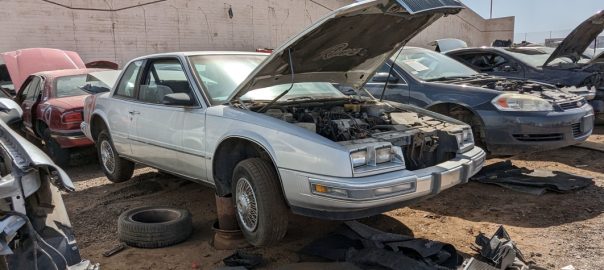
This ’92 Cadillac Eldorado is for sale near me, and somebody’s grandfather apparently took good care of it. It has just 77,000 miles, the CarFax shows it was regularly maintained at the dealership, and it has depreciated to a mere $3,199 ask (and even that’s over KBB book). That leaves money to spare for snow tires. A mechanic’s inspection is a must, but the Cadillac 4.9-liter V8 is generally regarded as dependable.

It has big ol’ buttons across the dashboard. The steering wheel boasts of its “supplemental inflatable restraint” (that’s 1992-speak for airbag). There’s a cassette player for when cassettes make their comeback. As for snow traction, 63% of the Eldorado’s weight is over the drive wheels.

It’s 1990s teal, the body looks good, and the cushy seats should clean up. I was surprised Riswick hadn’t claimed it, as he likes big touring coupes. Turns out he’d spotted it too.

Winter beater? Unless there’s some fatal mechanical flaw, this isn’t a beater at all.

2004 Nissan Xterra

Senior Editor Jeremy Korzeniewski: It’s not every day that your winter beater can also be a future classic. The fact that the Nissan Xterra doesn’t have the peerless reputation of the Toyota 4Runner actually helps us when looking for a decent set of wheels to tackle the winter. The one up above fits the bill with aplomb. It’s powered by a trusty (if not particularly powerful) 3.3-liter V6 engine and sends all 180 horsepower to the rear or all four wheels through a proper transfer case. With the right set of tires, this would be a great car for the winter, and it’d be fun to keep around for off-roading when the weather turns nice, too. It’s priced right at $4,495.

2008 Volvo XC70

Associate Editor Byron Hurd: How about a winter beater from someplace where they know a thing or two about winter? While Riswick started his search in Scandinavia, I landed here by accident. I was actually trying to track down a Magnum R/T with all-wheel drive, but that’s a rather sparse market. This will do. Yeah, I know what you’re thinking: It’s a high-mileage, “modern” Volvo from the Ford era. But for $4,500, it’ll do so long as the basic stuff functions, and the wagon format makes for a handy trucklet in other seasons too. The 3.2-liter six-cylinder and six-speed are both passable by modern standards, and even a 15-year-old Volvo is bound to be reasonably safe, which is a plus when surrounded by people who have never heard of winter tires. I just realized I’m starting to talk myself into actually buying one of these. Yikes. 

2005 Jaguar X-Type Sportwagon AWD

Senior Editor James Riswick: For the record, rule No. 2 was entirely written for me. I live in Agoura Hills, Calif., where winter typically consists of chilly nights, occasional mistiness and locals griping about the indignity of chilly nights and occasional mistiness. Wimps. Any way, to follow the rules, I’m going to pick something that’s passable for trips up to the local mountains where snow actually falls in abundance (two hours away) or road trips back home to Oregon. Front- or all-wheel drive was a given, utility was preferred, I didn’t want something from somewhere rusty, and as always, the car had to be interesting.

After multiple searches for Saabs and Volvos, I eventually stumbled upon this gem: a 2005 Jaguar X-Type Sportwagon AWD. Fun fact: This was the first Jaguar I ever drove. I recall actually liking my time behind the wheel, and the thing that made it lamentable back in the day (a Ford Mondeo Wagon wrapped in Jaguar XJ styling) makes it loveably kitschy today. As a wagon, it has the utility I want, including raised roof rails. It has all-wheel drive. It’s from Virginia, so no rust concerns. And it’s definitely interesting. I like this little guy. Yet another example of doing this exercise and walking away kinda wanting my choice for reals. 

Gas prices slide ahead of Thanksgiving week

Gasoline prices are headed lower going into the Thanksgiving holiday, creating a “tailwind” for drivers, predicts one energy analyst.

“People are going to have more money to spend based on spending less for gasoline,” Tom Kloza, head of energy analysis at OPIS, told Yahoo Finance Live. 

“There is going to be a significant tailwind for consumers on their expenses for fuel,” he added.

The national average for gasoline sat at $3.33 per gallon as of Friday, according to AAA data, down from $3.58 a month ago. Kloza says drivers can expect those prices to fall even more. 

I think we’re going to go through Thanksgiving weekend with an average price well below $3.25. And I think most people in the country, with the exception of those on the Pacific Coast, are going to be able to buy fuel for less than $3 [per gallon],” he added. 

Earlier this week, 11 states saw their average dip below the $3.00 per gallon level. Another fourteen were in a range between $3.01 and $3.25 per gallon.

Californians are still paying the most out of any area of the country with prices sitting at $5.02 per gallon as of Friday, down 57 cents in the last month.

Prices have been on a downward trend since September amid lower seasonal demand alongside use of less expensive winter grade gas.

Oil is also moving lower, headed for its fourth straight week of declines amid concerns of weaker demand and building inventories.

Crude futures now sit about 22% off their 2023 September highs, when calls for $100 per barrel became more common.

“I think that the predictions of $100 or higher were really hyperbole,” said Kloza.

“Between the summer and the beginning go the winter you tend to see a down cycle with crude that would take Brent to probably about $72 and change,” he added.

Concerns of a broadening conflict between Israel and Hamas caused prices to spike in October, only to unwind in recent weeks.

“What this proves is that you can have problems in the Middle East and all sorts of geopolitical possibilities. But until you prove it to the market, they’re not going to pursue those higher crude prices,” said Kloza. 

West Texas Intermediate (CL=F) crude oil was trading 1% higher on Friday, just below $74 per barrel after sliding more than 4% in the prior session. Brent (BZ=F) crude oil, the international benchmark was hovering above the $78 level.

Ines Ferre is a senior business reporter for Yahoo Finance. Follow her on Twitter at @ines_ferre.

Click here for in-depth analysis of the latest stock market news and events moving stock prices.

Read the latest financial and business news from Yahoo Finance

GM’s labor deal with UAW union on verge of ratification

Filed under:
,,,,,,

Continue reading GM’s labor deal with UAW union on verge of ratification

GM’s labor deal with UAW union on verge of ratification originally appeared on Autoblog on Thu, 16 Nov 2023 08:15:00 EST. Please see our terms for use of feeds.

Permalink | 
Email this | 
Comments

Porsche and Buick earn top honors in J.D. Power Sales Satisfaction Index Study

Filed under:
,,,,,

Continue reading Porsche and Buick earn top honors in J.D. Power Sales Satisfaction Index Study

Porsche and Buick earn top honors in J.D. Power Sales Satisfaction Index Study originally appeared on Autoblog on Wed, 8 Nov 2023 13:10:00 EST. Please see our terms for use of feeds.

Permalink | 
Email this | 
Comments

Waze will now warn you if a road has a history of crashes

Waze’s latest feature focuses on safety and will give you the knowledge needed to make an informed choice about the route you’re taking. The Google-owned navigation app has launched crash history alerts, which will send you a notification if you’re driving along a crash-prone road. Waze will publish a prompt that says “history of crashes” in-app before you reach, say, a curve that’s particularly tricky to navigate. That way, you can slow down or be on the lookout for anything that could derail your vehicle.

The app decides whether to show you a notification based on reports from the Waze community and an AI analysis of your route, such as its traffic levels, its elevation and whether it’s a highway or a smaller local road. It will not show you crash alerts for routes you usually take in order to minimize distractions, which suggests that its main purpose is to give you a heads up if you should drive with more caution than usual in places you’re not familiar with. 

Waze has released several protective features intended to keep you safe on the route you’re planning to take over the years. A few years ago, it started sending out real-time accident data so that you can take an alternate route if needed and first responders can get to accident sites sooner. In 2020, it also rolled out guidance prompts telling you to get in the right spot for an upcoming merge or exit before you get there.