The summer traveling season is nearly here, and many of us are itching to get out of town and enjoy the outdoors. If you’re like a lot of people, you’ve traded your sedan for a crossover or SUV because they’re more versatile. Light towing is one of the things that many compact and midsize crossover SUVs can do, and in the face of this shift in vehicle preference, a whole slew of suitable lightweight trailers are popping up.
But what if you’ve never towed a trailer? How do you get started if you’ve never towed at all? Perhaps you rented a U-Haul once and the attendant hooked everything up for you. Maybe your dad let you drive his rig for an hour or so on a family vacation a few times, but he drove the trailer in tight places and did all the hookups.
Towing is not overly difficult, and it takes no special license. But it’s not a trivial pursuit, either, and there several things you need to know to tow safely and confidently. Towing is a wide-ranging topic with many permutations, but for now we’re focusing on the lighter end of the spectrum where compact and midsize SUVs reside.
Here’s our comprehensive guide covering what you need to know before you tow.
1. Know your tow rating
The first step is to see if your vehicle is rated to tow at all and, if so, how much. The Trailering or Trailer Towing section in your owner’s manual is the best place to start. You might have to adjust to your carmaker’s specific terminology, though. On its own, the Towing section might refer to emergency towing behind a tow truck, while Dinghy Towing has to do with towing your vehicle behind a motorhome.
Once you find the right section, you may need to know your vehicle’s engine size, transmission type, drive type and even its trim level in the event your model has more than one possible tow rating. Sometimes certain options are called out, too. Full-size truck tow ratings can be quite difficult to pin down, but compact and midsize SUVs are much more straightforward.
![]()
2. Your practical tow limit is lower than your tow rating
Once you know your tow rating, you must consider your particular situation to determine your practical tow limit. That’s because published tow ratings are best-case maximums that are arrived at by assuming an unmodified, lightly-optioned tow vehicle piloted by a 150-pound driver traveling alone without luggage or cargo.
Your practical tow limit is therefore situational and will be lower than the tow rating to the extent that you weigh more than 150 pounds, travel with others, haul cargo or tote baggage, and own a tow vehicle that’s loaded with every available option or equipped with weighty add-on accessories. Basically, all of that weight must be subtracted so that, all told, your vehicle’s actual tow rating is in fact hundreds of pounds lighter than what is published.
3. Hitch considerations
Suitable trailer hitches may or may not come standard on vehicles that are rated to tow a load. In cases where there is a tow rating but the hitch is absent, the manufacturer will almost always offer a factory-developed accessory that can be bought from the dealer. Such hitches are made to fit the vehicle precisely, and they often include a trailer wiring adapter that’s easy to install.
You can certainly buy your hitch from a third-party hitch maker, but they may or may not be as well-contoured to the vehicle and as unobtrusive to look at as the factory-engineered unit. What’s more, third-party hitch sellers offer hitches for vehicles that have no tow rating, on the basis that receiver hitches make good mounting points for bike racks and other accessories. This distinction isn’t always obvious, but in no case should the availability of a hitch override the automaker’s towing recommendations.
![]()
![]()
4. Hitch components and their ratings
Hitches are composed of three parts. The receiver is a structure with a square receptacle that is always affixed to the vehicle. A ball mount is meant to be plugged into and securely pinned to the receiver when it’s time to tow and removed and set aside when it’s not. The trailer ball will effectively remain permanently bolted to the ball mount after being selected to match the trailer’s specific requirements (there are three available diameters).
All three of these components will be stamped or labeled with weight ratings of their own, and all three ratings must meet or exceed the vehicle’s tow rating. It’s important to note that overrated components do not increase a vehicle’s tow rating, but undersized ones represent the weakest link and must therefore lower it.
5. Know the trailer weight
It’s often impossible to weigh a trailer before you buy or rent. The most conservative approach is to go by the trailer’s GVWR (Gross Vehicle Weight Rating). This can often be found on the specifications sheet but is always stamped into a plate affixed to the trailer body. The trailer’s GVWR (not to be confused with your tow vehicle’s GVWR) represents the maximum amount the trailer should ever weigh.
But that figure might discourage you from trailers your vehicle can actually tow because trailer GVWRs sometimes greatly exceed their actual towed weight. I once rented a 1,000-pound trailer that had a 3,500-pound GVWR, but it only weighed some 1,700 pounds after I loaded it. Use care because loading considerations vary by trailer type – not to mention individual habit.
My tip here: You should inquire about the trailer’s empty weight, then compare that to the GVWR and consider what you will actually carry within the trailer.
5. The importance of hitching up before you load up
In short, the trailer should be coupled to the tow vehicle before you begin loading it.
Why? Trailers need to be properly balanced so they are stable when towed, and that comes about when the trailer tongue presses down on the trailer’s hitch point. But the balance is in flux as you load a trailer, and it’s possible that the Tongue Weight could go momentarily negative and the tongue could suddenly tip up as you load a heavy object in from the back.
![]()
6. Making the connections
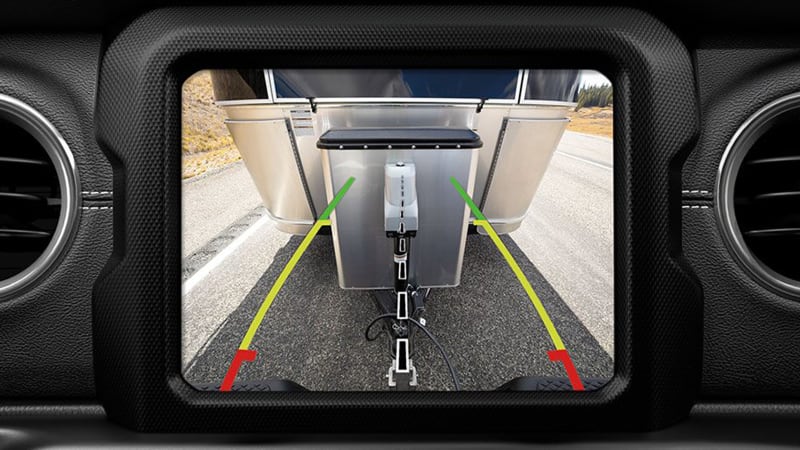
Backup cameras help a lot here, but nothing beats a helpful friend spotting for you as you gain experience. Make sure the trailer wheels are chocked, the trailer tongue is raised high enough and the trailer receptacle is unlatched. Back carefully under the trailer ball until it is centered, then set the parking brake and shift into Park. Use the trailer’s jack to lower the tongue receptacle onto the ball until it fully engages, then snap the latch closed.
Remember to insert a pin, bolt or specially-made lock to prevent the latch from bouncing open while driving.
Now connect the safety chain hooks to the ready-made holes or loops in the receiver, taking care to cross-cross left-to-right and vice versa to create a cradle underneath the coupling that could keep the trailer neck from hitting and potentially digging into the ground. Care must be taken so there is sufficient slack to prevent the chains from going taut when turning a corner, but there mustn’t be so much that they drag on the ground when driving straight. Next you’ll plug in the trailer light harness, taking the same issues into account with its slack. Finally, if the trailer has electric brakes and a breakaway switch, you’ll do the same when attaching that.
![]()
7. Tongue weight and loading your trailer
As mentioned before, a certain amount of downward pressure on the hitch ball, called tongue weight, is necessary to ensure that the trailer will tow straight and remain stable. That amount is almost always 10% of the trailer’s overall weight, though some heavier trailers require more. The tow vehicle’s rear suspension will compress a bit as it shoulders this load, but that’s expected and is accounted for in the rating. In all cases it’s not the weight itself that matters, it’s what it represents: that the trailer’s center of mass is situated ahead of its axle.
We rarely have access to scales when loading, but a few rules apply. Put heavier items ahead of the trailer axle, but not all the way towards the extreme forward edge. Center heavy items left-to-right and position them as low as practical. Secure loose items — particularly the heavier ones — so they can’t move and alter the trailer’s tongue weight underway. The goal is to have 60% of your cargo’s mass ahead of the trailer axle and 40% behind.
![]()
![]()
8. Trailer brakes
Trailers don’t always have brakes of their own. Brakes are more likely on heavier trailers, and at some point they are required by law. The carmaker may also have a tow rating cutoff point, above which they recommend trailer brakes. Check your owner’s manual for the vehicle recommendation, but also check your state’s requirement by using the AAA’s Digest of Motor Laws.
Of trailers that have brakes, there are two kinds. Hydraulic surge brakes are self-contained within the trailer’s tongue and use the natural hitch compression that occurs when the vehicle is slowed to apply a proportional amount of trailer braking. These are found mostly on boat trailers that are submerged in water and rental trailers hired out by move-it-yourself companies.
Electric brakes require a signal from the tow vehicle, and are therefore more complicated. These are most common in larger camping trailers towed by full-size pickups, which is why electronic trailer brake controllers are often optional in such vehicles (pictured above right). But some midsize pickups and crossovers are pre-wired to interface with an aftermarket trailer brake controller that may need to be added later. The weight threshold at which such brakes come into play does overlap with the high end of some crossover SUV tow ratings, so it is possible that you’ll need to buy and install a third-party trailer brake controller to make electric trailer brakes function.
9. Electrical connections
Numerous trailer lighting plugs existed in the past, but today we seem to have settled on just two: the four-pin flat connector and the seven-pin round connector. Vehicles with factory hitches may be pre-wired for both, but many add-on wiring kits are of the flat-four variety. You’ll need to know what the trailer has to understand which one you’ll need.
The flat-four connector is solely concerned with basic trailer lighting: running lights, brake lights and turn signals. These are common on trailers that either lack brakes or employ surge brakes. The seven-pin connector adds three possible functions to the list, the main one being a signal for electric trailer brakes. If your trailer has electric brakes, it most likely will have a seven-pin round connector at the end of its umbilical.
![]()
10. How to drive when towing
Check your vehicle carefully. Make sure your tires are fully aired-up on your tow vehicle and your trailer. Check the oft-neglected trailer spare tire’s pressure, too. Take care of any fluid top-ups and fill your tank just before you perform the initial trailer hookup at the start of your trip.
Once on the road, pull over and stop within the first 10 or 15 minutes to make sure the trailer connections are intact and the load remains secure.
Drive slower than normal. Many states have lower speed limits when towing, but others do not. Check the AAA Digest of Motor Laws for the states you will visit. Whatever you find, know that you should drive slower than usual for a variety of reasons. Your steering will react slower, and stopping distances will be much longer. You’ll be less able to respond quickly to unexpected situations, so the only way to gain extra response time is to proceed at a slower pace. Also, towing greatly reduces fuel economy and range. The aerodynamic drag of a trailer is a huge part of this, and speed makes a massive difference. Similarly, the extra drag represents extra strain on the engine and its cooling system.
Look far ahead. Looking as far down the road as possible is always recommended, but it’s even more critical when towing. For one, it helps you anticipate avoidance and braking maneuvers before they become critical. But looking far ahead also helps you stay centered in your lane. The temptation to stare at the lane markings close at hand is high, but invariably that tactic makes it harder to stay centered than looking well down your lane toward its horizon.
Accelerate and brake gradually. Acceleration usually takes care of itself because the extra weight will slow your rig naturally, but don’t overcompensate by flooring it right off the line. You’ll need to up the pace steadily once you get rolling, however, especially if there’s a freeway merge ahead. Braking needs to be gentle at first, too. Expect your stops to take much longer than usual, and begin slowing well before you normally would.
![]()
Swing wide. As the name implies, your trailer is trailing behind you, and its arc through corners will be much tighter than your own. You must delay your turn and swing wide so the trailer won’t ride up onto a curb at an intersection or clobber a bollard at a gas station. On winding mountain roads, it’s helpful to do the opposite of what you’d do in a sports car and allow your gaze to follow a turn’s outside lane line and imagine your outside front tire is tracking just inside it. You’ll need to use extra caution if you encounter cyclists, though.
Use the right lane. Some states restrict towing to the rightmost lanes, but it’s generally a good idea even when such rules do not exist. You’ll be going slower, so the bulk of the traffic in faster, and smaller vehicles will have a hard time seeing past you. Don’t be a physical or visual obstruction; stay to the right.
And please, on single-lane roads, be aware of cars stacked up behind you and get out of their way when safe by using provided turnouts.
Plan your exit when parking. Parking a tow rig is easiest if you can use curbside parking or pull-through spots. You may find that parking with the truckers works best. But you will find yourself in a supermarket lot at some point. Use larger retailers that are most likely to have a huge lot, and park in the back where it is emptiest. You’re going to need to take up multiple spots, but others will understand if you use the unpopular fringes. As ever, take care around curbs and planters, and stop where you can guarantee you can pull forward and away without obstructions.
Tips for backing up. This is a subtle art, but there are a few ground rules. Use a spotter. You won’t be able to see hanging tree limbs and roof eaves that could be a threat. Look over your shoulder, if you can, and place your hand at the bottom of the rim. This offsets the fact that the trailer will go the opposite way that you think — at least at first. Go slow, and use small initial movements. If you get crossed up, pull forward to realign and try again. If you are trying to turn a trailer into a spot, know that you may have to switch the direction of your steering mid-stream to prevent the trailer’s new arc from tightening overmuch. This reversal can put your tow vehicle’s forgotten front corners at risk, so make sure you are looking everywhere all the time.
Trailer towing is an acquired skill that will greatly expand the ways you can use your vehicle. It’s absolutely worth learning how to tow a trailer, and it will become second nature as you gain experience. Like anything else, start small, take your time and don’t take shortcuts. Done right, towing in of itself is neither pure fun nor a dreary chore, but is instead a satisfying challenge with a payoff at the end in the form of outdoor fun at a far-off location.
Related Video:











 Need to give the car a wash? Deliberating between doing it yourself or going to a professional car wash? If you don’t have the time, desire, or supplies to clean your car at home, then it’s time to hit the pros. There are three types of places you can go to get your car washed, all with differing degrees of effectiveness. Options include a quick…