All posts by Ozzie

Study: Ram has the worst drivers of any auto brand

While specific auto brands don’t make people worse drivers, it seems to be true that certain types of drivers gravitate toward different makes and models. A recent study from LendingTree found that drivers of some brands rack up more accidents, DUIs, and other citations at much higher rates than others.

Ram drivers were the worst of the 30 brands LendingTree analyzed, with 32.90 incidents per 1,000 drivers between November 2022 and 2023. Only Tesla and Subaru came close, with 31.13 and 30.09 incidents, respectively. The 10 car brands with the most driving incidents in the study include:

  1. Ram
  2. Tesla
  3. Subaru
  4. Volkswagen
  5. Mazda
  6. BMW
  7. Lexus
  8. Infiniti
  9. Hyundai
  10. Toyota

Breaking things down further, Tesla drivers had the highest accident rates, followed by Ram and Subaru. The study also found that BMW drivers had the highest DUI rates, with almost twice the number of DUIs of the second-closest brand, Ram.

LendingTree analyzed tens of millions of QuoteWizard by LendingTree insurance quotes from Nov. 14, 2022, through Nov. 14, 2023, to determine the number of driving incidents per 1,000 drivers — gauging accidents, DUIs, speeding, and citations. It noted that Ram drivers had more speeding incidents than all other brands and said that the Ram 1500’s quick acceleration played a role.

Mercury, a brand out of business for more than a decade, had the safest drivers. Pontiac and Saturn, also dead for years, earned the second- and third-best spots on the list, perhaps because owners of those cars aren’t driving them often, or are not filing insurance claims on them.

Beyond the meme potential here, there are real-world consequences to poor driving, and the brands most associated with it can carry higher insurance rates. Getting a DUI or having repeat traffic offenses are great ways to lose your license, and they can also lead to your insurer dropping your policy. Your driving behavior also has a far greater impact on the insurance rates you pay than the type of car you drive, however, as higher-risk clients pay much more on average than those with clean records.

Best Large SUVs of 2024

Filed under:
,,,,,,,,,,,,,,,,,

Continue reading Best Large SUVs of 2024

Best Large SUVs of 2024 originally appeared on Autoblog on Tue, 19 Dec 2023 06:00:00 EST. Please see our terms for use of feeds.

Permalink | 
Email this | 
Comments

What is Apple CarPlay and what does it do?

Using your smartphone while driving isn’t a great idea, and we’ve seen historically that telling people not to do it and even threatening them with big tickets hasn’t stopped them. Since people won’t stop interacting with their phones in the car, in 2014 Apple came up with a way to connect an iPhone (Android users can use Google’s Android Auto in a similar manner) to a car to keep your eyes on the road while still staying connected, and it’s a method that’s both safer and more convenient due to its hands-free driving usability. It’s called Apple CarPlay and it will do everything from read your texts for you to help you get where you’re going. Here’s a simple beginners guide to Apple CarPlay with all the information you need to stay hands-free while driving.

When did Apple CarPlay debut?

Apple CarPlay was announced to the public at the Geneva Motor Show in 2014 with Ferrari, Mercedes-Benz and Volvo signed on as the first manufacturers to adopt the standard. The first vehicle to hit the market with a full implementation of CarPlay was the 2014 Ferrari FF. From there, it spread to more affordable models from a whole host of manufacturers such as Hyundai, VW, Chevrolet, Honda and Ford.

What cars are compatible with Apple CarPlay?

As of November 2023, all car brands sold in the U.S. offer CarPlay except for two: Rivian and Tesla.

General Motors, meanwhile, announced plans to phase out CarPlay in its EVs, which we’re seeing first in the 2024 Chevrolet Blazer EV. General Motors claims that vehicles which shipped with CarPlay from new won’t have it disabled by future vehicle updates.

As to what older cars use CarPlay, Apple has a handy list that will tell you definitively if your specific model of vehicle came with Apple CarPlay integration.

How does Apple CarPlay work?

To get a little technical, Apple CarPlay is a standard created by Apple that allows a vehicle’s infotainment system to mirror your phone. This means that many apps that you know and use every day like Maps, Podcasts, Spotify, Messages can be used without needing to touch your actual phone and it also means you’re not at the mercy of factory systems which can vary considerably in ease of use and general responsiveness.

Apple CarPlay’s best features

  • Light mode/dark mode: CarPlay will automatically switch between a light mode and a dark mode in your vehicle based on whether your headlights are on, but if you want to force it to stay in one mode until you change it, you can.
  • Dashboard view: Usually, CarPlay’s display shows you what a single app at a time is doing, but you can also swipe right from the main screen to access “dashboard mode” which will display several apps at once. We use this all the time.
  • Navigation alerts to your Apple Watch: If you have an Apple Watch connected to your phone and that phone is currently running CarPlay and either Apple Maps or Google Maps, it will send directions and alerts to your watch to make sure you don’t miss that next turn.
  • Remembering where you parked: Apple Maps and Google Maps will both drop a pin automatically if you park your car and disconnect your phone. It makes finding your car again super easy.

How do I enable Apple CarPlay?

As of 2023, CarPlay comes in two flavors: wired and wireless. The difference between these is fairly self-explanatory, but both have advantages and disadvantages. Wired CarPlay allows you to charge your phone while driving and also provides a higher standard of audio, if that’s something you’re into.

Wireless CarPlay uses Bluetooth, so once you do the initial pairing and activation of wireless CarPlay by following the prompts on your phone, you shouldn’t have to touch it again. Anyone with an iPhone 5 or later running iOS 9 or later can use either wired or wireless Carplay. CarPlay does not work with iPods or iPads, so don’t even try.

What apps are compatible with Apple CarPlay?

Many native Apple apps have built-in CarPlay equivalents, but third-party apps like Spotify or Google Maps, for example, require direct permission from Apple to add CarPlay functionality. Examples of popular third party apps include IHeartRadio, Waze, Overcast, Zoom and WhatsApp.

Is Apple CarPlay useful?

Aside from the safety factor and the familiarity of using apps you already know and trust, one big benefit of CarPlay is that it’s always the same, regardless of what car you get into. For example, if you get out of your 2022 Honda Civic daily driver and want to load up your 2019 Ford F-150 for a weekend of camping, you’ll have the same seamless infotainment experience in both vehicles. It’s also extremely handy if you and a significant other share a car.

How to connect Apple CarPlay to an older car

So, now you’re convinced that Apple CarPlay is a good thing and you’ve got an iPhone that works with it, but your older car sadly doesn’t. What can you do to remedy this? Thankfully, this doesn’t mean that you necessarily need to go car shopping. Many aftermarket car stereos now come with Apple CarPlay integration that works as seamlessly as it would on a factory system.

Many of these systems are what’s known as “double DIN” which refers to the size of the opening needed in the dash to fit them, but most cars have this already. Depending on how handy you are, you can typically install one of these aftermarket stereos yourself, though it’s usually best to have a professional do the install for you. Prices for these start at around $170 before installation.

New cars under $23,000 that have Apple CarPlay

If adding CarPlay to an older car seems like too much trouble, or if you’re already in the market for a new car, this list of the cheapest vehicle models that you can buy in 2023 that have Apple CarPlay should be a big help. None of these vehicles will cost you much more than $23,000, and that’s not bad.

NHTSA’s proposal to require anti-drunk-driving tech is up for public comment

The National Highway Transportation Safety Administration announced this week that its “Advanced Impaired Driving Prevention Technology” proposal has entered the public comment phase, meaning now is your chance to voice your feelings about new tech designed to passively monitor the blood alcohol content of drivers. If the new rules are adopted, the tech could become mandatory in all cars sold in the United States, Reuters reported Tuesday

“Between 2011 and 2020, an average of almost 10,500 people died each year in alcohol-impaired driving crashes,” NHTSA’s report said. “The agency has seen record increases in overall traffic fatalities over the last few years of the COVID-19 pandemic, likely reflecting increases in alcohol- and drug-impaired driving.”

“Concerted efforts by NHTSA, states, and other partners to implement proven strategies generated significant reductions in alcohol-impaired driving fatalities since the 1970s when NHTSA records began; but progress has stalled. While the causes of the recent fatality increases require further study, and NHTSA continues to support strategies to change driver behavior, more must be done to reach our goal of zero traffic fatalities,” the report said.

NHTSA’s recent push to make the tech mandatory stems from a report released following a fatal two-car accident that occurred in California in 2021. 

The tech at the center of this push is not new, strictly speaking. In fact, it has been in development for at least the better part of a decade. The preferred system utilizes two detection methods. The first is a device similar to a standard breathalyzer mounted on the steering wheel, which can passively monitor the driver’s breath; the second is a near-infrared light scanner installed in the ignition switch that can detect alcohol via the user’s skin.

NHTSA also acknowledged that the tests must not only be effective, but reliable. Acting NHTSA Administrator Ann Carlson told Reuters that there are close to 1 billion separate daily driving journeys in the United States.

“We are trying to see, can we get it done, does the technology exist in a way that is going to work every time,” Carlson said. “If it’s 99.9% accurate, you could have a million false positives,” Carlson said. “Those false positives could be somebody trying to get to the hospital for an emergency.”

Members of the public will be able to comment on the proposed rules via http://www.regulations.gov/ (Docket # NHTSA-2022-0079). NHTSA’s instructions for submitting comments are pasted below. They don’t make it easy:

How do I submit a comment on Regulations.gov?

The “Comment” button can be found on the following pages:

  • Docket Details page when a document within the docket is open for comment,
  • Document Details page when the document is open for comment, and
  • Document Search Tab with all search results open for comment displaying a “Comment” button.

Clicking “Comment” on any of the above pages will display the comment form. You can enter your comment on the form, attach files (maximum of 20 files up to 10MB each), and choose whether to identify yourself as an individual, an organization, or anonymously. Be sure to complete all required fields depending on which identity you have chosen. Please note that information entered on the web form may be viewable publicly. Once you have completed all required fields and chosen an identity, the “Submit Comment” button is enabled.

Upon completion, you will receive a Comment Tracking Number for your comment.

Some agencies also accept comments by mail, fax, or email. To find out if you can use one of these alternate methods, visit the document’s section labelled “Addresses.”

Users cannot submit comments on documents published by Non-Participating Agencies.

For step by step instructions, please see the Submit a Comment article.

Note: The comment due date on Regulations.gov is based on Eastern Time. For example, if the comment due date is 02/05/2019, then you have until 02/05/2019 11:59PM ET to complete your comment on Regulations.gov.

Related video:

.embed-container { position: relative; padding-bottom: 56.25%; height: 0; overflow: hidden; max-width: 100%; } .embed-container iframe, .embed-container object, .embed-container embed { position: absolute; top: 0; left: 0; width: 100%; height: 100%; }

Pedestrian fatalities most often occur at night, and that’s a recent, scary change

The problem is thorny and disturbing, and the potential causes are many. But credit the reporters at The New York Times for making a brave attempt to explain why and how more than 7,300 pedestrians died in America in 2021 — three in four of them during the hours between sunset and sunrise.

The report, titled “Why Are So Many American Pedestrians Dying at Night?” chronicles the sharp rise in nighttime fatalities over the past 15 years and suggests factors at play here besides merely darkness: the distractions of smartphone use — both by drivers and by pedestrians — fiddling with digital display devices on or near the dashboard; increased use of drugs by drivers; and more people walking along roads that were not designed for pedestrians.

A year ago, Autoblog looked at the same data, and we noted a couple of factors the Times only touches on or does not mention: Like the Times, we highlighted that pedestrians are often dressed in dark clothing, rather than for visibility. We also noted, anecdotally, that pedestrians often don’t exercise the fundamentals of safe walking, sometimes jaywalking or stepping out without making eye contact with motorists. As for roads not designed for pedestrians, we noted that three-quarters of pedestrian deaths occur in a location other than an intersection, where a driver is at higher speeds and would least expect to encounter someone walking. And though we often hear about drunk driving, there’s this surprising statistic: In 32% of fatal crashes, the pedestrian had a blood-alcohol level exceeding 0.08% — too impaired to drive may also mean too impaired to make coherent decisions on foot. In comparison, in 10% of pedestrian fatalities, the driver was drunk.

In Portland, Oregon, the story quotes Dana Dickman, the traffic safety section manager for the Portland Bureau of Transportation, who says, “Now we have folks that are living, working, shopping, going to school directly on these roads that were essentially built as highways.”

“It’s clear that there’s been a particularly American mix of technological and social changes over the past decade and a half,” the Times writers say. “And they have all come on top of a road system and an ingrained culture that prioritizes speed over safety. Whatever has happened over this time has reversed years of progress on daytime pedestrian fatalities, too, leading to a modest increase in deaths.” Then they return to the main thesis: “Nighttime, however, has the potential to amplify so many of these new risks.”

Experts as well are called on to comment on what’s caused “a growing gap” in reports of fatalities between the U.S. and other advanced nations. But there’s no consensus. Reports the Times, “these trends present a puzzle that has stumped experts on vehicle design, driver behavior, road safety and how they interact.”

“’I don’t have any definitive answers for this,’” Jessica Cicchino, the vice president for research at the Insurance Institute for Highway Safety, told the writers. “Ms. Cicchino, like many observers, has puzzled over how rapidly nighttime deaths have risen. ‘What is it that’s happening specifically in the dark?’”

Could it be that the predominance these days of vehicles that are “wider, longer, taller and heavier” — the letters “SUV” don’t appear in the story here — contributes to the rise in pedestrian injuries?

Not necessarily. “While researchers have pointed toward vehicle size as a factor explaining America’s high overall rate of pedestrian fatalities, several said they were skeptical that it explains much of the increase since 2009,” reports the Times. “That’s because American cars were relatively large even before 2009, and the rate at which new cars replace existing ones is slow.”

There are other details worth exploring in the report, which is available here. A subscription to the Times may be required.

The Times also has a companion piece, called “The Rise in U.S. Traffic Deaths.” It charts the way that vehicle deaths have risen in the U.S. to a rate up to five times higher than that of Scandinavia, Switzerland or Britain.

NYC’s $15 congestion tax wins initial approval

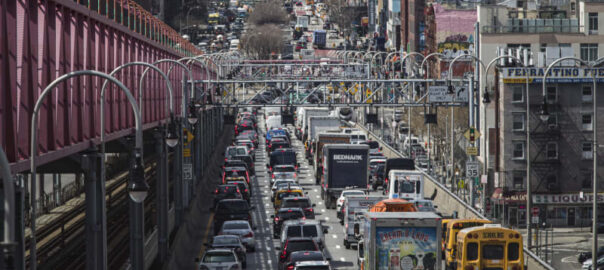
New York City’s plan to charge motorists driving into Manhattan’s central business district inched forward as a proposed tolling structure received an initial approval from the Metropolitan Transportation Authority.

The MTA’s governing board voted nine to one Wednesday to allow the tolling program to move forward. The agency, which operates the city’s subways, buses and commuter rail trains, is implementing the congestion pricing tolling plan. Passenger cars with an E-ZPass will pay $15 during peak periods, while trucks pay $24 to $36. It’s the first such program in the US.

The initial approval allows the MTA to begin a public comment period on the tolling structure. Officials anticipate congestion pricing will bring in $1 billion annually that the transit agency will borrow against to raise $15 billion for its $51.5 billion multi-year capital budget. That spending plan includes modernizing subway signals, extending the Second Avenue subway to 125th Street and adding escalators and elevators to make the system more accessible for everyone.

Congestion pricing gives the MTA, which already has $47 billion of outstanding debt, a new revenue source to fund necessary infrastructure needs, said Neal Zuckerman, an MTA board member who chairs its finance committee.

“We’re spending 15% of our operating budget servicing that debt,” Zuckerman said. “Congestion pricing is necessary for plugging the gap of the building, the repairing, the fixing we must do.” 

The MTA is eager to get the new toll revenue flowing into its capital budget. It has already delayed a $1.3 billion project to update signals on the A and C subway lines in Brooklyn because its funding relies on congestion pricing revenue. More project delays could come. The anticipated cash from the tolls would account for up 50% of the remaining funding in the MTA’s capital plan.

“We’ve knocked out as many of the projects as we can that did not depend on congestion pricing,” Janno Lieber, the MTA’s chief executive officer, said during Wednesday’s meeting.  “Now we’re coming to the point where we really start to need that money.”   

The goal is for drivers to start paying the toll in May or June, but a New Jersey lawsuit may push out the implementation. Governor Phil Murphy has filed suit to get a court to force the MTA to undergo a longer environmental analysis.   

The MTA can make some changes to the tolling structure. The transit agency will now analyze how to exempt public school buses from the toll after some board members raised concerns. The board also mentioned giving a break to yellow-taxi passengers, although incorporating that type of change could be challenging, Lieber told reporters after the board meeting.

“When you make tweaks to it, it definitely creates diversions, different traffic patterns, which then have to be restudied,” Lieber said. “And in a doomsday scenario, would run afoul of the limits placed by the environmental assessment.”

Related: NYC’s $15 Congestion Pricing Risks Delay From New Jersey Lawsuit

The fee would apply once a day to drivers entering Manhattan south of 60th Street from 5 a.m. to 9 p.m. on weekdays and between 9 a.m. and 9 p.m. on weekends, with tolls 75% lower during the night. There’s a 50% increase for vehicles without an E-ZPass. The proposal includes a credit for drivers entering the district through certain tunnels.

The plan includes potentially boosting the tolls by 25% during so-called gridlock alert days, which is the holiday season and also the United Nations’ General Assembly.

The toll wouldn’t apply to taxi drivers and for-hire vehicles, but instead charge passengers per ride, $1.25 for taxis and $2.50 to those in ride-shares like Uber or Lyft.

The tolling plan calls for a $5 credit to passenger vehicles entering Manhattan through four tunnels: Queens-Midtown connecting Manhattan to Long Island City, the Hugh L. Carey — a bypass to downtown from Brooklyn, and both the Holland and Lincoln which connect to New Jersey. Small trucks would get $12 while large trucks and tour buses would receive $20.

John Samuelsen, Transport Workers Union’s international president and a non-voting MTA board member, has said the MTA needs to add more express bus routes in underserved areas and more frequent local bus service to get more commuters to take public transportation instead of driving. Samuelsen was on the Traffic Mobility Review Board, which recommended the tolling structure. He resigned last week, saying the program doesn’t include sufficient service changes.

“We’re talking about targeted service increases, perhaps in the far reaches of the outer boroughs, that would encourage those who currently drive to get out of their cars and onto public transit,” Samuelsen told reporters after the board meeting.

Aggressive driving climbs in many cities over holidays, says GasBuddy

For drivers living in Tucson, Ariz., it might be safer to walk to the pizzeria on New Year’s Eve instead of to drive. Alcohol has nothing to do with it.

On the other hand, residents of Minneapolis should have no qualms about taking the car to pickup a pie.

Those suggestions follow the results of a rather unscientific survey taken by GasBuddy to assess driving habits in the US during the holiday season. It found that drivers “are up to 48 percent more aggressive on the roads” during that time of year.

The study ranked the top 50 U.S. metros from most to least aggressive, placing Tucson at the top of the “naughty list,” and Minneapolis as the city with the “nicest” holiday drivers, rising six spots from seventh place in 2022. You can see some of the other most and least aggressive cities in the image at top.

How was the study accomplished? Well, GasBuddy ‘”Drives” is an opt-in, in-app feature that tracks users’ trips and provides a fuel efficiency score by recording aggressive driving habits; those “naughty” habits include hard braking, fast acceleration and speeding. The team looked at 8,149,863 of these recorded trips, or “drives,” across 50 metropolitan areas from November 23 to the 26, over the Thanksgiving weekend, measuring the number of events of speeding, hard braking and fast acceleration.  The organization averaged the amount of aggressive driving events in each city to reach a total, which was then compared to the national average. 

“Driving during the holiday season can be stressful, but it’s important to remember to stay calm and courteous on the road,” said Patrick DeHaan, head of petroleum analysis at GasBuddy. “Additionally, aggressive driving can negatively impact fuel efficiency, causing drivers to waste money that could be spent on holiday celebrations or gifts for loved ones.” 

We would also add that you should be thoughtful and safe on the roads during the holidays to make sure you get home safely to enjoy them with your loved ones.

Related Video:

.embed-container { position: relative; padding-bottom: 56.25%; height: 0; overflow: hidden; max-width: 100%; } .embed-container iframe, .embed-container object, .embed-container embed { position: absolute; top: 0; left: 0; width: 100%; height: 100%; }

Consumer Reports: Nearly half of tested EVs fall short of their advertised range

Time and again, American consumers say that one of the biggest barriers to entry to the EV marketplace is range. Compounding the potential for range anxiety in an EV purchase is the fact that estimates are just that, and many have found that their electric cars frequently offer less real-world range than advertised. To help keep them honest, Consumer Reports decided to evaluate the highway range of its EV test fleet and see just how far each of its cars would go until they just couldn’t go anymore. The team tested EVs from the U.S., Korea, Japan and Germany and the best (and worst) performers just might surprise you.

While CR breaks down its results very matter-of-factly, we’re going to (somewhat arbitrarily) arrange them into three categories: those that convincingly beat their estimates (20 miles better than advertised or more), those that didn’t (20 miles or worse than expected), and those that managed to fall almost exactly where CR expected (within 19 miles of their EPA figure). With that out of the way, let’s dive in. 

The good

Score one (or six?) for the Germans. Always eager to sandbag, BMW and Mercedes had excellent showings here, and while we’re at it, let’s give Ford and Rivian some credit for hanging with the luxury brands from overseas. While the R1T is hardly a mainstream pickup, the Mach-E is a bit more bread-and-butter. Just goes to show, you don’t have to spend premium money to get a good EV these days. 

  • BMW i4 M50
  • BMW iX xDrive50
  • Ford Mustang Mach-E Premium AWD Extended Range
  • Mercedes-Benz EQE 350 4Matic
  • Mercedes-Benz EQE SUV 350 4Matic
  • Mercedes-Benz EQS 580 4Matic
  • Mercedes-Benz EQS SUV 450 4Matic
  • Rivian R1T

The bad

This list is surprisingly short, but it’s populated by some big names. Ford certainly won’t be happy to see the F-150 Lightning hanging out down here, especially when you consider that Consumer Reports wasn’t even doing truck stuff when they tested it; things undoubtedly get worse with a payload or trailer to contend with. As for Lucid and Tesla, well…

The shockingly accurate

Mona Lisa Vito had a better term for it, but it’s one we won’t print here. Many of the cars CR tested managed to come so close to their estimates that they might as well have been right on the money. Both the Genesis GV60 Advanced and the Kia EV6 Wind beat their estimates by just three miles; others, like the Ioniq 6 SEL AWD, fell short by just a few. All of these were within 20 miles of their prescribed range, however, which is pretty darned good for a real-world result. And while we’re certain Audi and Volkswagen would have preferred to stand alongside their brethren in the “Good” category, this will have to do. 

As always, check out CR’s results for the full figures.

Related video:

.embed-container { position: relative; padding-bottom: 56.25%; height: 0; overflow: hidden; max-width: 100%; } .embed-container iframe, .embed-container object, .embed-container embed { position: absolute; top: 0; left: 0; width: 100%; height: 100%; }

Editors’ Picks November 2023: Toyota Grand Highlander, Buick Envista and some lovely luxury vehicles

Filed under:
,,,,,,,,

Continue reading Editors’ Picks November 2023: Toyota Grand Highlander, Buick Envista and some lovely luxury vehicles

Editors’ Picks November 2023: Toyota Grand Highlander, Buick Envista and some lovely luxury vehicles originally appeared on Autoblog on Fri, 1 Dec 2023 16:40:00 EST. Please see our terms for use of feeds.

Permalink | 
Email this | 
Comments

AAA survey: We know what safe driving looks like, we just don’t always do it

Traffic volumes have made a big comeback post-pandemic, and though the post-pandemic high rate of traffic fatalities has started to ease slightly, deaths among pedestrians and cyclists remain on the rise. An annual AAA study sheds light on the type of driver behind these statistics. The news is, the majority of us admitted to bad driving behavior even though we know better.

The AAA Foundation for Traffic Safety interviewed 2,499 drivers for the survey and parsed them into six types, and dived deep into their driving behaviors. The organization asked drivers questions about their attitudes toward safety — as well as their actions behind the wheel in the previous 30 days. Often, attitudes did not match actions, and only 41% of drivers surveyed fell into what AAA calls its “Safe Drivers” category. 

In other words, 6 in 10 of us admitted to unsafe driving, in particular, speeding. The survey categorized 27% of respondents as “Speeding Drivers.”

“Despite acknowledging the dangers, some drivers continue to engage in potentially deadly behaviors, particularly speeding,” said Dr. David Yang, president and executive director of the AAA Foundation for Traffic Safety. “Understanding the different types of risky driving behaviors and the characteristics of drivers who engage in them is crucial for developing targeted interventions to achieve safe mobility.”

The Traffic Safety Culture Index (TSCI) report slotted survey respondents into six driver profiles:

  • Safe Drivers: Few engaged in any risky driving behavior. 
  • Distracted Drivers: Predominantly engaged in all distracted driving behaviors, most notably cellphone use. 
  • Speeding Drivers: Predominantly engaged in speeding behaviors. 
  • Distracted and Aggressive Drivers: Predominantly engaged in both distracted and aggressive driving behaviors. 
  • Impaired Drivers: Predominantly engaged in impaired driving (e.g., drunk driving). 
  • Most Dangerous Drivers: Engaged in all risky driving behaviors

According to the 2022 index, 93% of drivers said those who use a cellphone to text or email or read while driving are “very” or “extremely” dangerous. Drivers also agreed that somebody important to them would disapprove if they did it. However, 27% of drivers admitted they have sent a text or email while driving, 38% have handheld a phone during a call, and 37% read a text or email.

Some 83% of those surveyed said driving through a red light was “very” or “extremely” dangerous, while 89% condemned aggressively switching lanes or tailgating. Yet, fewer drivers consider speeding as a dangerous activity and had the “lowest perceived social disapproval,” with approximately half saying they have traveled 15 mph over the speed limit. 

“Many risky drivers in this study were classified into profiles that involved speeding behavior. Focusing on speeding drivers will deter other risky driving behaviors like impaired driving and red-light running. This traffic safety measure will have the greatest impact on safety,” said Yang.

The biggest concern for “very” or “extremely” dangerous driving is drowsy driving, with 93% agreeing this is bad. Nonetheless, in the past 30 days, 18% reported they have driven drowsy. 

And 94% said impaired driving is “very” or “extremely” dangerous. Out of those surveyed, 7% said they have driven after drinking alcohol, enough to qualify for a DUI.

In comparison, 70% of drivers are concerned that driving with THC in their system is “very” or “extremely” dangerous. Only 6% of drivers stated they have driven after using THC within an hour. That percentage is up compared to the TSCI numbers in the 2021 index.

These unsafe behaviors such as speeding, alcohol involvement and non-use of a seatbelt have played a crucial role in the number of traffic deaths, according to the National Highway Traffic Safety Administration (NHTSA). The rise in pedestrian fatalities has been particularly alarming, and Secretary of Transportation Pete Buttigieg has called this a “national crisis of traffic deaths” and has allocated billions of dollars in infrastructure spending to address it.

You’ll find more details in the full AAA Traffic Safety Culture Index study report