Notice: Function _load_textdomain_just_in_time was called incorrectly. Translation loading for the wp-rss-aggregator domain was triggered too early. This is usually an indicator for some code in the plugin or theme running too early. Translations should be loaded at the init action or later. Please see Debugging in WordPress for more information. (This message was added in version 6.7.0.) in /home/inthedri/public_html/wp-includes/functions.php on line 6170 Ozzie, Author at - Page 29 of 73 Deprecated: Function WP_Dependencies->add_data() was called with an argument that is deprecated since version 6.9.0! IE conditional comments are ignored by all supported browsers. in /home/inthedri/public_html/wp-includes/functions.php on line 6170
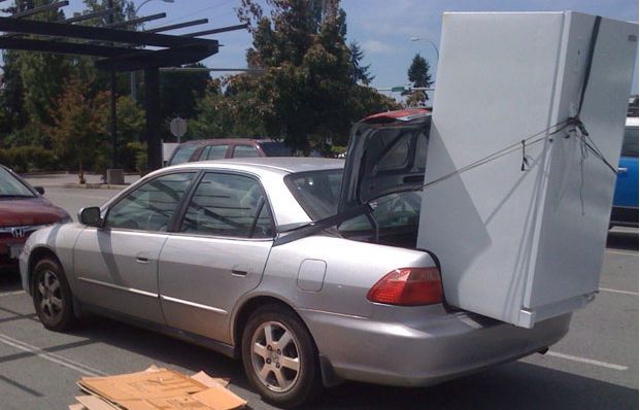
What is wrong with people? Would you do this with your new car? A full-sized refrigerator is a pretty sizable appliance, usually requiring at least a van or pickup truck to haul to its destination. But some people, and there’s no good way to put this, some people are just idiots. The picture above is a real picture. Someone really tried to transport a refrigerator that way. It was also something the police in Richmond, British Columbia, had to remind a shopper who thought a few ropes and a prayer would get this fridge home in the trunk of a Honda Accord.
Police said they received a call of a dangerous driving situation outside a store called Liquidation World. As you can see in the above photo taken by the RCMP, the fridge — secured with ropes tied to the rear seat belts…SEAT BELTS! I don’t know about you guys, but I don’t think this would instill a lot of confidence I I saw this guy in from of me on the Highway.
What was the craziest thing you’ve seen someone try to transport in their vehicle? Maybe they should consider coming to Freeman Grapevine for something a bit larger.
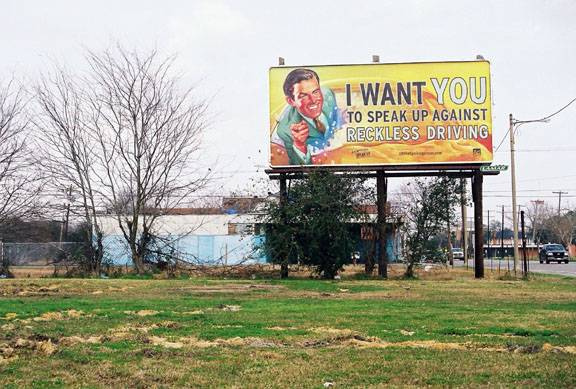
What is an unsafe or reckless driver? Think of it this way, is it someone who speeds or someone talking on their cell as they blow through a stop sign? It’s obvious the latter.
I’m not going to preach to anyone that ‘Speed Kills’ when it has been proven that speed on it’s own is not the killer. We all exceed the speed limit. It’s when you mix in your in ability to control your vehicle because you lack focus. Basically, it’s speed combined with any of the following
1) Drink or Drugs
2) Dangerous Driving
3) Reckless Driving
…. this is what causes the accidents and kills.
Please, always remember. Be safe, be alert, be cautious and arrive alive.
httpvh://www.youtube.com/watch?v=fFLRlAdEo-o
Now the general tone of this video was humorous, but trust me when I tell you that there are plenty more reckless driving videos on the net that I could have pulled up that would have ruined your day. For the time being I hope this video puts some people back in touch with reality when they get behind the wheel.
Focus. Be alert. Know your surroundings, including vehicles, pedestrians and objects. If you refuse to stay vigilant behind the wheel, then you are driving recklessly by default. Please drive carefully.
This is just a friendly reminder from your me and the rest of us at Freeman Grapevine.
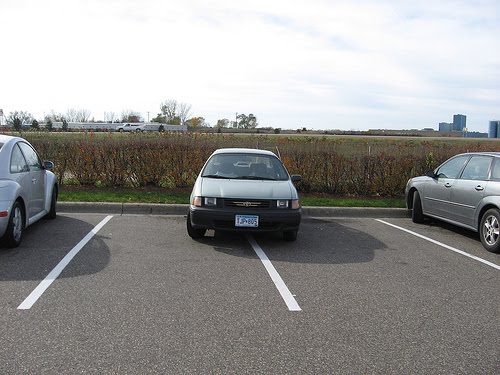
I don’t know if people have stopped caring about how they park their cars or what, but I think a refresher course in parking is a must! Even if you think you are good at parking your vehicle I still think you should have a read of these great tips on how to correctly park your cars!
Something that I’m sure not only annoys just me is when is when people double park their vehicles. It always happens when you’re running late and that super close parking spot that would be just perfect for you is only half the size you need it to be because someone decided to use just part of it.
In attempts to rid of people of doing that, here are some great tips parking tips for your cars! Some of these tips may be pretty basic, but heck, you’ve got to start somewhere!
Park where cars are allowed to be parked.
If there are painted lines for your parking spot, try to park in the center of them. Never park across them.
Use your parking brake. You never know when you might end up with an escape artist.
If you have an automatic vehicle, put it inpark. If you have a manual, leave it in gear.
If you park on flat surface leave your wheel straight. If you park facing downhill turn your wheels to the right (towards the curb) just in case your car gets loose it will just run into the curb and stop itself.
Park uphill by turning your tires away from the curb. Turn wheels to the right if you have don’t have a curb and are uphill.
When you are exiting your parking place always look out in the traffic before you move. And use your turn signal well.
Don’t try to squeeze into a parking space. This will only result in door dings and possibly some angry folks who can barely get into their own car.
Use common courtesy when it comes to parking your vehicle. Bad parking can ruin someone’s day and could even result in some unnecessary door dings. And no one likes door dings! If you have any parking tips or stories you’d like to share, we’d love to hear from you! Comment below or stop by Freeman Grapevine Buick GMC today!
Q: What’s one of the worst things that can happen to your engine?
A: Really poor “timing” changing your timing belt.
Let’s say that your vehicle is roughly 6 years old. You’ve never had any issues mechanically and as far as you are concerned, the engine purrs like a kitten. You may even pop your hood every now and then to tug on your fan belt, fill your wiper fluid, heck, maybe you can even change your own oil. However, there is a engine killer that lurks in the dark that rarely gets checked or is even remembered. It’s your timing belt.
Here’s the rub when it comes to changing your timing belt at the manufacturer’s prescribed intervals. Let’s say, for years your car has just been the perfect vehicle. Until one day you are cruising along and the engine suddenly goes dead silent. Guess what? Your vehicle’s timing belt failed!
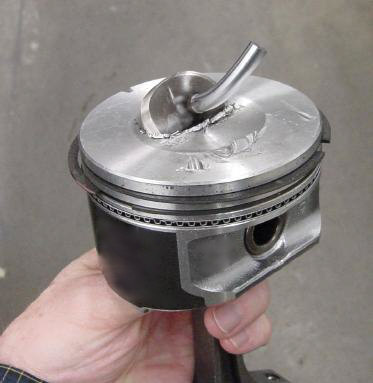
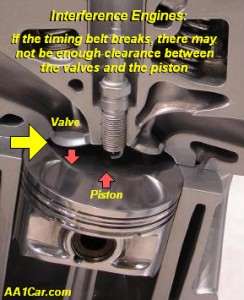
Now is when the real pain starts. Not only do you have to pay for the tow and the belt replacement, but also a costly valve job due to the damage the broken timing belt has caused. You’re one of the unfortunate car owners with an “interference engine” …A What?– That is an engine that can leave one or more valves still propped open far enough to contact a piston with valves and the belt parts. Sadly, car sales brochures don’t list whether or not an engine might suffer catastrophic damage if the belt goes. But trust me…a broken timing belt will leave you with considerable more expenses. In fact, you might have to replace your engine all together.
Check out the video below for more…engine terror:
httpv://www.youtube.com/watch?v=DGh-3fvK61I
So, as you can see the mere act of reading your owners manual and paying better attention to your maintenance schedule can save you from making a costly mistake of omission. Remember, in most cases, the broken timing belt unpleasantness could have been prevented with timely maintenance. I can’t say this enough: Replace the timing belt according to your vehicle manufacturer’s recommended schedule. It’s just that easy.
If you’d like to avoid a catastrophic engine seizure or your manual (hint, hint) says it’s time for a change. Don’t wait. Call me so I can save you time, money and all of the headaches that also come with a broken timing belt.
If you’ve never experienced a tire blowout, let me just tell you that it’s beyond scary. This is especially true if you don’t know how to handle the vehicle in this situation. There are several reasons a tire may blow out. The two most common reasons have to do with the air pressure. Too low of pressure causes the tire to flex more than they are designed to, and if the pressure if too high, the tires a stressed beyond the designed limits.
The easy way to avoid a blowout, is to check your tire pressure at least once month (especially during the summer). However, checking the tire pressure is not a sure-fire way to avoid a blowout. There could be a defect in the tire itself or the wheel, in which case you’d be none the wiser.
The best thing I can suggest to you is to be prepared. Know what to do and what to expect when it happens.
Step 1: Stay cool.
Ignore your natural instinct to hit the brakes or jerk the steering wheel when you have a blowout.
Step 2: Accelerate slightly.
Accelerate slightly to maintain control of the vehicle. Keep going straight.
Tip: Hold the steering wheel firmly with both hands at 10 o’clock and two o’clock on the wheel to avoid losing control.
Step 3: Decelerate.
Ease off the accelerator slowly.
Step 4: Coast.
Maintain your course while the vehicle slows.
Step 5: Apply brakes.
Apply the brakes gently when your car slows to 30 miles per hour.
Step 6: Turn on right turn signal.
Tip: Never stop on the left side of the road, if possible. This is the most dangerous place to be.
Step 7: Pull over.
Pull your vehicle off to the side of the road, and breathe a sigh of relief…you’ve just survived a blowout.
Science Fiction, or Science Fact? The self-inflating tire: I know we’ve all heard of it’s purported existence, but now it looks like it may come to fruition. That means no more loud compressors, say goodbye to leaky hoses and inaccurate tire gauges. The good people at the Goodyear Tire & Rubber Company have apparently developed a system which will allow tires to self-inflate automatically.
The technology that Goodyear has developed is called Air Maintenance Technology (AMT) and is completely self-contained, without any need for external pumps or electronics.
“While the technology is complex, the idea behind the AMT system is relatively simple and powered by the tire itself as it rolls down the road,” said Jean-Claude Kihn, Goodyear senior vice president and chief technical officer.
Here is some theory behind the science.
httpv://www.youtube.com/watch?v=hxmcG4xCjlE
Now that you know that self-inflating tires are indeed Science Fact don’t bother searching the net just yet for this new tire technology, Goodyear has yet to provide any costs, or even an estimate when the technology will become available to the public. However, don’t let that crush your self-inflating dreams. Goodyear has received grants from the United States Department of Energy’s Office of Vehicle Technology to help further development.
Aside from the “cool” factor, keeping your tires at optimal operating pressure delivers lower emissions, longer tire life, enhanced safety and improved vehicle performance.
Stay tuned for further details. I’ll keep an eye on this topic for a future post. How great would it be if keeping your tires at optimal pressure just meant a quick trip to the corner store for some milk? It’s just one less maintenance issue you will be responsible for in the future.
…to seeking cover under an overpass during a tornado
The misconception is that the wind associated with a tornado is confined to within the visible funnel cloud. Unfortunately, a tornado is not a vacuum cleaner hose hanging out of the sky. One possibility why many people think that being under an overpass offers protection is that with something above them, the bridge will prevent the wind from going ‘up’ underneath the overpass. This simply is just not true.
There is no doubt that essentially living at the southern tip of tornado alley we get to see our fair share of destructive tornadoes. Being in your home is one thing, you can take shelter in an interior room. However, what do you do if you are caught out on the road? I know every one’s first instinct is to protect their car and themselves and their first instinct is to take shelter under the nearest immovable object like an overpass. If you know anything about physics, you should rethink this tactic. The fact of the matter is that you may have just made your situation much worse.
Actually, the interaction between a tornado and an overpass is much more like this.
…and here’s a visual reference behind the science.
This is why one of the first and foremost rules in general tornado safety is to get as low as possible, because that is where the wind speed is the lowest! By climbing up underneath the overpass, you are moving into a place where the wind speeds are typically higher. In addition, under an overpass, it is possible in some situations that when air is forced through the narrow passage underneath the bridge, this might cause an increase in the wind speeds (as mentioned earlier). Further, under different circumstances, the area beneath and just downstream of an overpass might become a debris deposition zone, where piles of debris accumulate. Think a hard rain is uncomfortable? Try being pelted with glass, shards of metal, splintered wood, hail and everything else that’s been hurled into the air.
If on a road, hide under an overpass if a tornado approaches.
The sad fact is this idea has caused many deaths of motorists already. The worst thing you can do is hide under an overpass. Winds can actually be worse under an overpass which makes it a bad place to go. Please listen, never use an overpass for protection.
Open your windows during a tornado? Scientists once thought that the low pressure in a tornado caused the normal air pressure in
houses to explode out. It turned out that the strong winds from the tornado destroyed the
houses, not the pressure change. If the tornado wants your windows open, it will open them for you.
The southwest corner of a basement is the safest place to go during a tornado.
The best place to go during a tornado is in a center room of the basement, like ones that are usually found under the stairs that lead down to the basement. I was once thought that the SW corner was the best place to go, but it was found the debris collects it the corners which makes it a bad place to go.
Tornadoes can’t cross water or where rivers meet. Many tornadoes have crossed rivers & lakes, with out any effect to the tornado.
Tornadoes can not cross big hills or mountains.
Tornadoes have made damage paths up and down the side of 10,000 foot mountains, in Wyoming so the hills in eastern Kansas will not protect you.
Tornadoes can’t/don’t hit big cities. Miami, FL, Nashville, TN, Wichita, KS, Fort Worth, TX, and Oklahoma City have all been hit by tornadoes in the past few years. Take shelter if a tornado warning is issued for your city.
To see what happens when you take shelter under an overpass take note of the people the pass before under the overpass and again after they drove back through.
httpv://www.youtube.com/watch?v=xJkDphU5olo
So far, this has been the deadliest year for tornadoes across the US. North Texas and specifically DFW (none of us forget the tornado that his Fort Worth) are susceptible to extreme weather. It’s my responsibility to make sure that all of you are provided with the best information possible about your car, driving, etc. However, it’s just as important , if not more-so, that you understand the appropriate action to be taken should you ever encounter a tornado while on the road…What you decide to do or not do can potentially have fatal outcomes. I hope you will remember this article if you ever are in this situation.
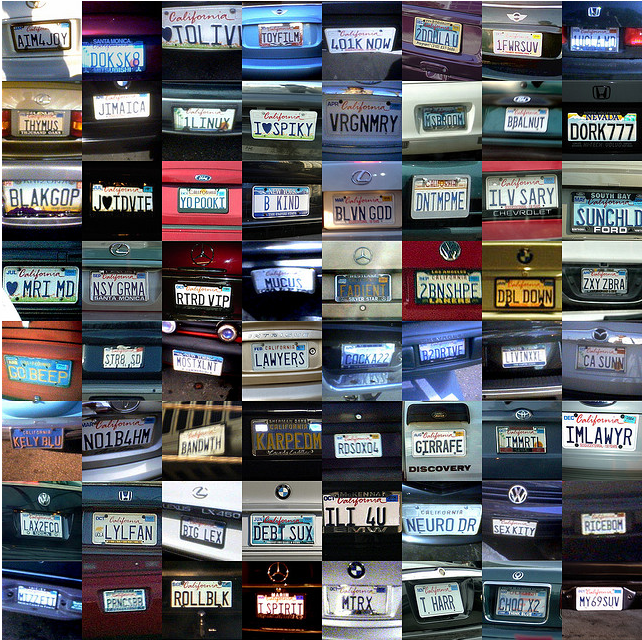
We all seen them. You may actually have one. The Vanity license plate. It can say a lot about the driver who owns the plate. I’ve personally never owned a vanity, but I’ve certainly seen my fair share.
Well, as it turns out, the vanity plate has come a fairly long way in a relatively short period of time. What was once an fairly low cost way to personalize your vehicle has now become big business.
After years of selling vanity plates as a modest sideline — charging as little as $5 — states think there’s more money to be made in whatever drives people to buy them. Facing budget crunches, states are raising surcharges or proposing annual fee hikes for custom plates.
Texas has gone a step further. It hired a private company to raise $25 million over the next five years by auctioning off vanity plates.
“People like to express themselves, especially in Texas,” says a spokesperson for the Texas Department of Motor Vehicles.
In fact, vanity plates can boost self esteem for the simple reason that vanity plates say “who I am and what I want people to know about me”. It’s like a mission statement.
In turn, a paper published in the Journal of Applied Social Psychology in 2008 found that drivers with vanity plates, bumper stickers and other “territory markers” were far more likely to use their vehicles to express rage — by honking, tailgating and other aggressive behavior.
This year, at the nation’s first such auction, Texas sold 33 plates for $139,400. That’s a hefty chunk of change!
However, don’t think that you can just get anything on those plates. I believe all states who allow vanity plates also regulate what you can and can’t express. States have long denied certain combinations of letters or numbers considered obscene or inappropriate, sparking battles with motorists….and well, some are just down, right dumb like: “3XWYVS,” “H8CATS” and “TROFYWIF.”
So, if you were going to get a vanity plate, what would it say? Leave me a comment below, let’s see how creative you can get!
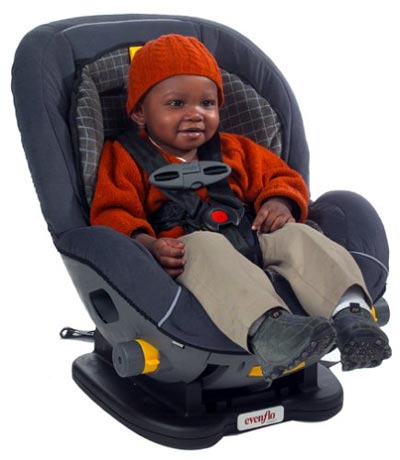
Researching information regarding safety for children, I came upon an article written by the American Academy of Pediatrics on car seats and wanted to share it with you.
All parents have the same worry when traveling with children – safety. What happens if I am in a car accident, will my child be safe? Every year we have accidents that injure or kill young children. It goes with out saying that the proper use and installation of child safety seats have helped keep children safe. Now, the question is, with so many safety seats being sold, which no doubt overwhelms most new parents, which seat is the right one for your child? The article helps with many questions a parent may have regarding safety seats.
The right safety seat for your child depends on several things like child’s size and type of car you have. Below is a quick guide produced by the American Academy of Pediatrics on the different types of car safety seats to help you start your search. But you still need to read more about the features and how to use your car safety seat.
Age Group
Type of seat
General Guidelines
Infants
Infant seats and rear-facing convertible seats
Infants should ride rear-facing until they reach the highest weight or height allowed by their car safety seat’s manufacturer. At a minimum, children should ride rear-facing until they have reached at least 1 year of age and weigh at least 20 pounds. When children reach the highest weight or length allowed by the manufacturer of their infant-only seat, they should continue to ride rear-facing in a convertible seat.
Toddlers/preschoolers
Convertible seats and forward-facing seats with harnesses
It is best for children to ride rear-facing as long as possible to the highest weight and height allowed by the manufacturer of their convertible seat. When they have outgrown the seat rear-facing, they should use a forward-facing seat with a full harness as long as they fit.
School-aged children
Booster seats
Booster seats are for older children who have outgrown their forward-facing car safety seats. Children should stay in a booster seat until adult belts fit correctly (usually when a child reaches about 4′ 9″ in height and is between 8 and 12 years of age).
Older children
Seat belts
Children who have outgrown their booster seats should ride in a lap and shoulder seat belt in the back seat until 13 years of age.
If you have any questions about proper car seat installation, you can always swing by and I’d be more than happy to show you the right way to secure the seat and keep your child safe.
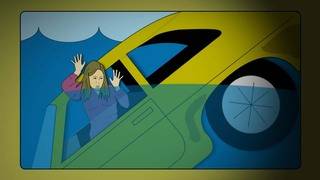
This is something we hear on the news from time to time. A car loses control, crashes through a retaining barrier and into a body of water. Would you know what to do if this happened to you?
This type of accident is rare, but that doesn’t mean it can’t happen to you. Thinking back on what you know or what you’ve heard, do you think that you would have the presence of mind to recollect the escape tactics that you’ve “heard” about and not panic? For sake of argument, I’m going to say “no”, you won’t. That’s OK, because until I did a little refresher research, I would have fallen into the same category as you: Knowing the theory of escape, but that’s about it.
Here’s a website dedicated to this very subject written from a person who’s experienced being trapped in a submerged car first hand. It’s definitely worth looking at.
The bottom line is that you have to remember to stay calm and memorize this simple course of action:
Here’s one more thing to consider. There are small, inexpensive, and convenient-to-carry tools available to the public that are made specifically to shatter a car window to free a trapped victim. I suggest you look into getting one for your vehicle.
One is called a LifeHammer. It is only 7 ½ inches in length and weighs 4.9 ounces. It is shaped like a small hammer but with a dual conical shaped hardened steel point at one end. A strike with medium force will shatter a side window. I had my 10 year old daughter try it and she broke the window on the first try. The LifeHammer also has a seatbelt cutter built into the other end. The LifeHammer should be mounted in the vehicle either on the side of the console or anywhere it can be easily reached in an emergency. You can view one by clicking anywhere you see the word “LifeHammer”.
The other tool is called ResQMe. It performs the same functions as the LifeHammer but it is only 3 inches long, weights just over ½ oz. and easily attaches to your keychain. One advantage of ResQMe is that it can go with you wherever you go as long as you have your keys. You can view one by clicking anywhere you see the word “ResQMe”. The Life Hammer is a little more robust and can be used to clear out some of the shattered glass once the window is broken. I keep ResQMe on my key chain and a LifeHammer in my car.
Be prepared, stay calm and know your escape routes. If you have any questions or comments, let me know. If you’d like to share any experience you may have had that is similar, tell us that too…you may save some one’s life one day with your information.